


E pluribus unum is the most famous Latin phrase inscribed on the Great Seal of the United States of America. It means, of course, “out of many, one.” But where did this aspirational idea really come from? And what does it mean, 250 years after the founding of a nation that now looks much different?
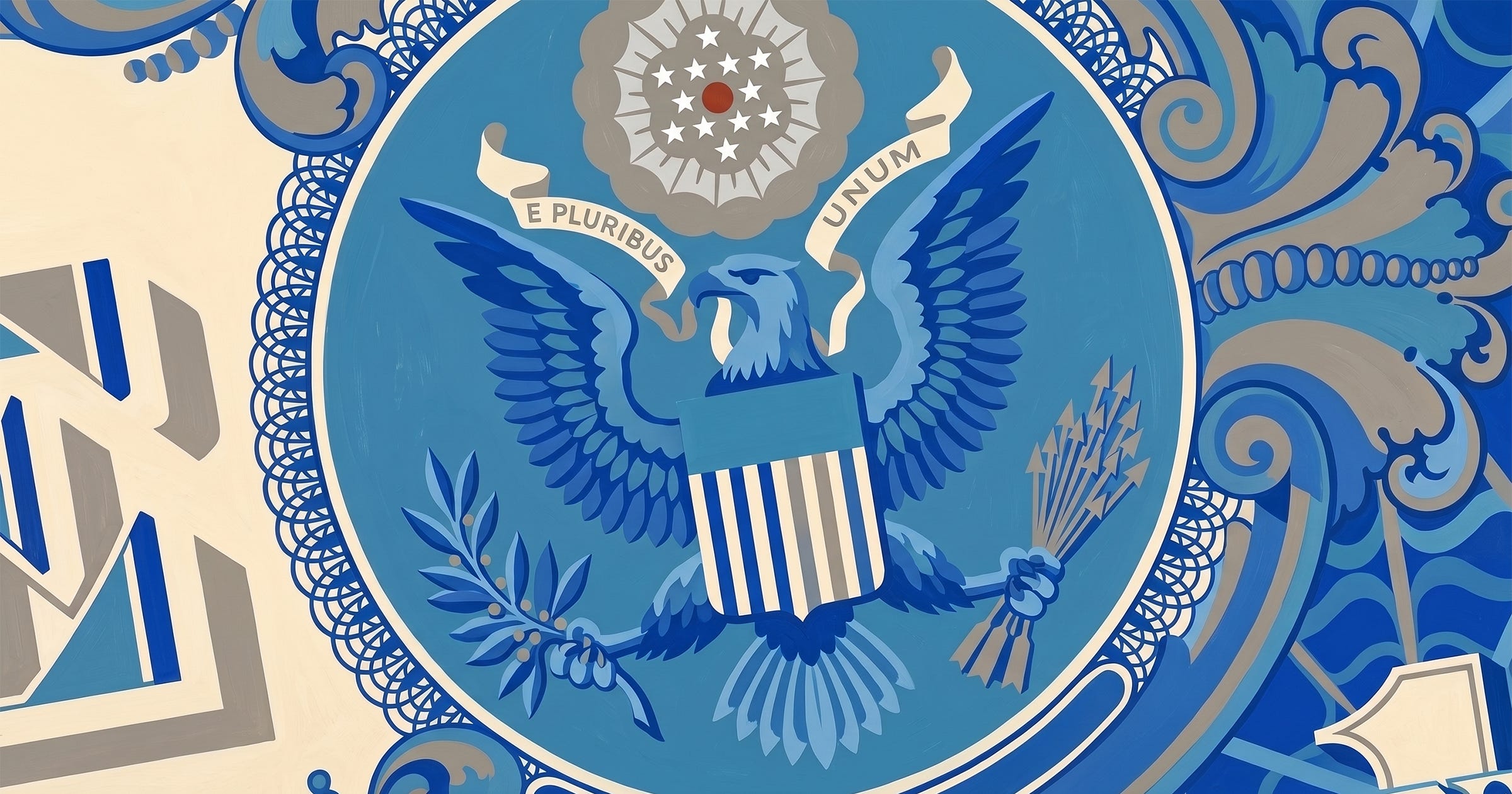
In its early association with the U.S., the phrase described the often precarious union of the original 13 colonies at war against the British. Its official connection with the cause of independence began in August 1776. Just a few weeks after the Declaration was published, a kind of design competition was commissioned for a seal that would accompany official documents published by the new government. The first draft was rejected for various reasons. Six years later, however, when a design could finally be agreed upon, e pluribus unum joined an image of an eagle clutching arrows in one foot and an olive branch in the other as the official seal of the Continental Congress.
Right from the start, “out of many, one” was as aspirational a motto for the new nation as it was descriptive. As the prolonged debate over the seal itself suggests, the 13 colonies were fractious and argumentative. Despite their differences, however, they knew they needed each other, certainly to win a war against the British Empire. “We must, indeed, all hang together,” as Benjamin Franklin famously said, “or most assuredly we shall all hang separately.”
The existential imperative of correctly balancing unity with diversity continued to be a major theme of the Early Republic long after the fighting stopped. Following ratification of the Constitution, one of the first acts of the new Congress was to adopt the Continental Congress’s seal as the official Great Seal of the United States. Developed in wartime, its message was still needed in peacetime. E pluribus unum has appeared on the country’s official documents ever since.

The problem of forging an “unum” out of so much “pluribus” has only become greater in time. The original draft of the seal—the one discarded back in 1776—attempted to give representation to all the 13 colonies and even the nations of origin that most of the colonists had emigrated from. These symbols of representation included the lion for England, the harp for Ireland, the fleur-de-lis for France, and so on.
Today, of course, no such attempt at representation could even be made, as Americans’ nations of origin are as numerous as the nations of the earth. Instead, we must be content with the imagery of diversity, given to us by history, as it appears on the seal, and extend its symbolic value to cover contemporary circumstances: 13 olives, 13 arrows, 13 stripes, 13 stars, and 13 letters in the phrase e pluribus unum. These are the symbols that today represent three hundred forty million people living across three and a half million square miles.
The “unum” of the United States has regularly been tested throughout our history, most terribly, of course, during the Civil War. Likewise, each major wave of immigration has been accompanied by periods of upheaval and unrest. Economic strife, cultural change, war—all of these have seemingly given the lie to, or at least encouraged cynicism about, notions of unity amidst diversity.

One of the enduring questions of the USA’s 250th anniversary is: Can the one survive with so many? And another is: Can the many be respected even as they become one? So far into the American experiment, these remain live questions—questions each subsequent generation of Americans must ask and answer anew. These are challenging problems and our answers have often been messy.
But part of the greatness of the country is that we keep striving toward the answer. For the entire history of the United States, we have lived within the inherent tension—often excruciating tension—of reconciling unity and plurality. Injustice, violence, exclusion, and degradation have been perpetrated by advocates on either side of the equation. So have justice, peace, inclusion, and collaboration. This tension is a distinctive feature of the American system, not a bug.
Tension, even painful tension, can be a powerful source of creativity and dynamism. The success of the United States in integrating so many different peoples while becoming so prosperous and powerful is a case in point. Working out the tension of E pluribus unum is one of the major projects of the United States of America. At times this project has been the source of pain and national shame; more often, however, it has been the very catalyst for so much that has made us great.
Forging a workable national culture from extraordinary diversity is the impossible homework assignment given to us by the country’s founders. For 250 years, we haven’t stopped trying. That’s made all the difference.
Caleb Whitmer is a project manager at the Acton Institute’s Center for Social Flourishing and a co-producer and writer for the forthcoming documentary film Poverty Trap: How Big Plans to End Poverty Broke the Promise of America. A graduate of Hillsdale College, he lives outside Grand Rapids, MI with his wife and children.

