


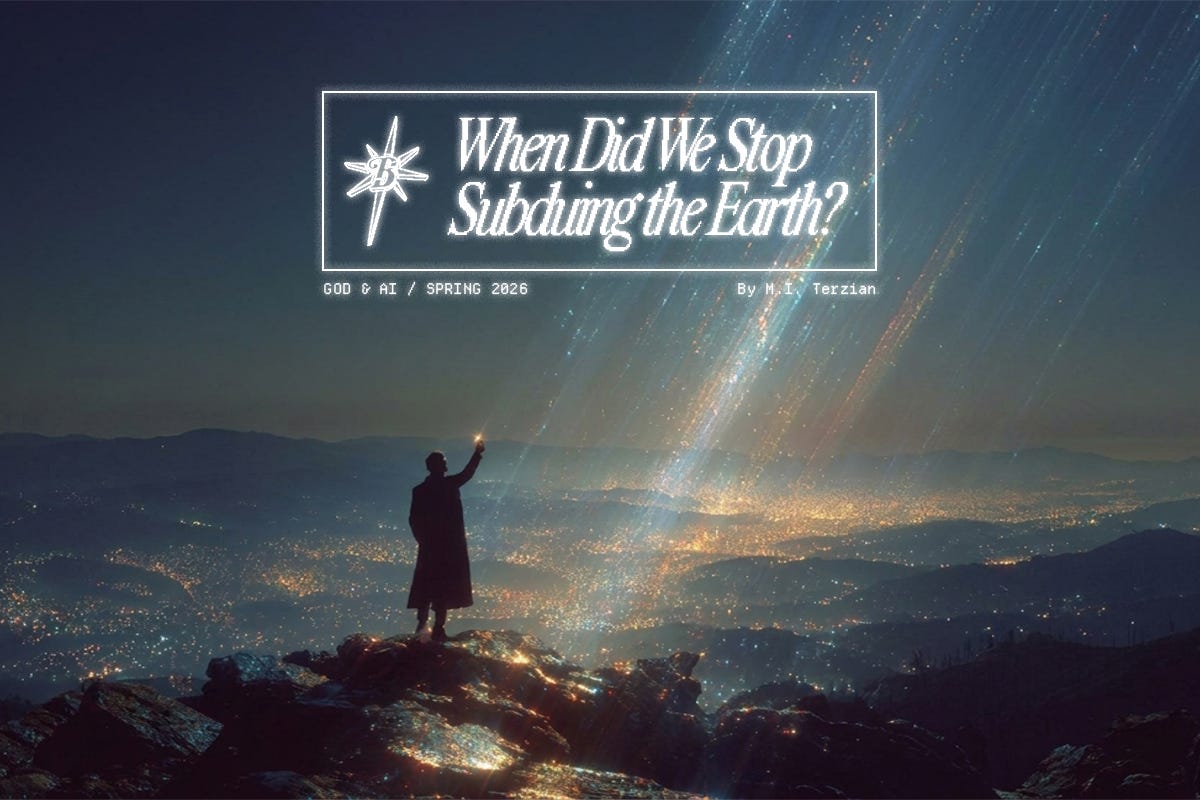
A few years ago I was in Joshua Tree National Park watching a line of satellites cross the sky. I had seen the same train of satellites in Asia, Europe, and the Pacific Islands. They have become sentinels over earth, always there if you know where to find them.
What were the odds 10,000 years ago when God said “Be fruitful and increase in number; fill the earth and subdue it,” that it would actually happen? In many ways, despite our best efforts at self-sabotage, humans have been incredibly successful in subduing the earth.
We often forget that before the cross, before Abraham, and before Babel, there was the Dominion Mandate, and clearly it is still in effect.
The Dominion Mandate is our ultimate quest–God’s explicit purpose for our being. Its derivative, the Great Commission, commands us to make Christian disciples of all nations. It’s striking that in our present obsession with “choosing good quests” and “appearing Christian” (nice, fair, stable, reliable, honest), we are blindly and hastily trading in God’s ultimate commands in favor of things much less interesting or meaningful. We make gadgets instead of tools, and politely appease instead of spreading God’s word.

For believers, this aversion to Dominion comes in two flavors. First, we are so often worried about appearing arrogant—being seen as building tools of domination, rather than dominion–that we have largely abandoned and stigmatized “subduing the earth.” Second, we are worried about how being “boring”, polite Christians might impact our competitive edge, and because of that we often become boring, polite seculars.
I assumed that when I first picked up the Bible for myself in my late teens, I would find a basis for all of the moral emphasis and piety I saw in the church. Instead, I saw the opposite. Those who cared most about being “right” had almost no ability to be “good” or follow God. As it turns out, you have to choose.

Goodness Versus Rightness
Being “good” inherently means you are more often right, but that is not the aim. Following God means that you are more often good and right despite not caring much about either.
When following God conflicts with being good or right, we ought to follow God. There are many in Christian culture that cannot distinguish God from their definition of ‘good’ or right, and so are neither while desiring both. Many have discovered that you can appear “right” about almost anything by criticizing it and doing nothing of consequence yourself.
So say we want to be the best at subduing the earth, accomplishing the great commission, and building tools of dominion rather than domination. In the history of science, the greatest odds of doing hard, irrefutable work is generally not found in those popular secular scientists whose theories are still being debated today, but most often with those who looked past the traditions of our faith, fell in love with the person of Christ, the majesty of God, and did rather unpopular and irrational things because of it.
Take God at his word and imagine with me what the implications of the uncompromised dominion mandate would have been had we not excluded ourselves from Eden. Would we have the same, similar, or greater population? Would we have tools like cars and satellites? What in our industrialized world today is a product of sin, and what is a tool of dominion?
We often confuse the fact that some technologies exist to address the consequences of sin as an explanation for why all technology exists. This belief is in part to blame for Christians backing out of the marketplace.
But the Luddite position doesn’t address at all why humans, even when left to our own devices, compulsively build things and organize the chaos around us. The upwards trajectory of humans, our global expansion, and the tools we use to accomplish it are not evil things to be minimized but the hallmark of our creator.

Nothing New Under the Sun
Contrary to the present narrative, the spiritual strangeness of the Bible consistently comes into greater alignment with science over time. Many, like the examples below, have become impossibly good one-line explanations of very complex scientific discoveries within the last 200 years.
Take Deuteronomy 5:9 “I, the Lord your God, am a jealous God, punishing the children for the sin of the parents to the third and fourth generation.” 5,000 years later, we discover a genetic mechanism for generational patterns. What we say and do changes the expression of our DNA and is measurable, specifically, to the third and fourth generations (Epigenetics).
The Ritual Washing in Leviticus addressed the same hygiene problems Florence Nightingale famously implemented during the Crimean War, restoring the bodies of soldiers, which Christ calls our “temple”.
The father is consistently described as the protector and the provider, which happens to also be true of the placenta in the mother’s womb, where we’ve recently discovered that the father’s genes dominate.
Circumcision on the 8th day is because that is when an infant’s blood has sufficient vitamin K to coagulate for the first time. Muslims got this one wrong and suffer the torture of circumcising 8-year-olds.
Because the Bible consistently predicts realities science only later uncovers, we have to admit that it is not a retroactive book of rules or a mere reflection of life, but the source itself.
Had we simply trusted the word of God and been obedient to his commands we would have been good, right, following God and moving on to more meaningful quests when there was no rational evidence to support it.
Outside of this frame and the moral example of Christ, the incentive to sacrifice one’s life to make incremental scientific and economic discoveries does not exist in society. Sacrificial love is the engine of trust that built Western Civilization.
Dominion Versus Domination
So why have we found ourselves backing out of long-held positions in the front rank? We have, in many ways, caved to the respect of men (Acts 10:34-35). America’s westward expansion was reframed as genocide, half a million American deaths in the Civil War as being political, the overflow of American missionaries as being imperial.
Christianity is unique among the world religions, being only one of two which has a global commission. The other, Islam, stands in stark contrast. The expansion of Islam via Jihad is a directive to world domination, not stewardship via dominion. It is in many ways the anti-dominion mandate. Islam even has special admissible moral compromises when expanding, including lying and deception. (Based on the Hadith). A large portion of the Quran describes how and when to wage holy war as opposed to the crusades, which was a circumstantial and for its time, quite normal war that had no directive in the bible, especially not the New Testament.
The presence of Jihad has seen modern cultures regress into the strong dominating the weak, instead of the weak being served by and protected by the strong. This is the distinction between dominion and domination.
On the other hand, the expansion of Christianity in the 20th century was marked by the modernization and establishment of the 21st century’s most prized institutions. Christian missionaries invented thousands of alphabets and are responsible for almost 90% of world literacy by population, especially in places like the Indian subcontinent, South America, even so far as a Greek missionary inventing the Russian alphabet as part of his mission to the then pagans of the Ural Mountains.
Christian missionaries helped found 50% of democracies, almost all of public education, higher education, and the judicial system. They eliminated large-scale institutional slavery, established laws against abuse of every nature, largely exterminating cannibalism, incest, and human sacrifice.
My point to those more concerned with “doing good” than enacting God’s will is this: you may have built a great brand, and are philanthropic with its proceeds, but you didn’t give a country their language.
The tragedy is that by “lacking in zeal” (Romans 12:11), we have surrendered to people who have no moral basis to choose anything other than domination. This explains both the rise of Islam, secularism and their effects.
I see no moral danger in men and women imperfectly working out their creative gifts, speaking up and being wrong, aspiring to dominion, whether it succeeds or fails. I see great moral danger in demonizing the participation of good men at the messy forefront of human progress, ignoring what God asked of us, and handing the authority that comes with it to the last person to abandon their pursuit of power.
We must be clear, God’s will, the outcome, does not change, but how much pain or prosperity we must endure to arrive at it is determined only by virtuous men righteously exercising their agency. Our most impressive feats of science are just a sliver of revelation from God’s existing creation, and without Christians in the front rank, exercising dominion, many will suffer.
Mishak I. Terzian is the pseudonym of a Christian Industrialist, raised in the Middle East and based in the Midwest, building companies that subdue the earth.

