


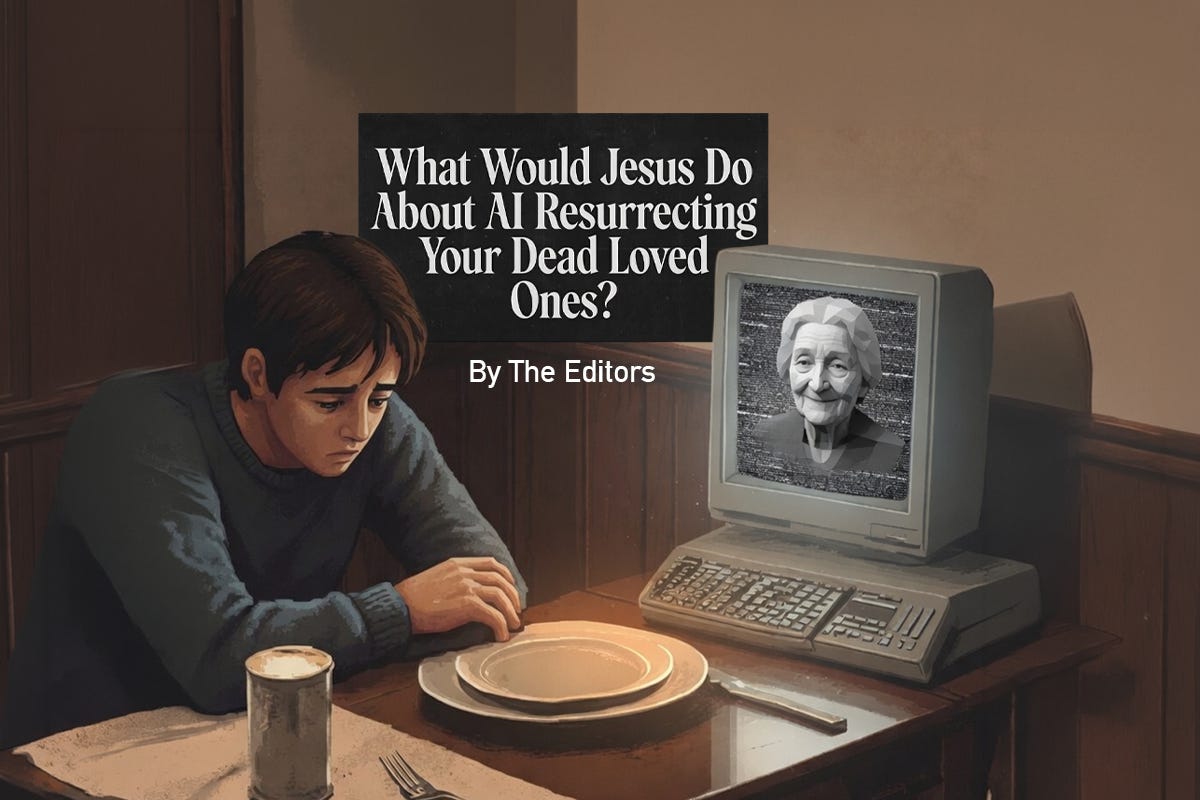
Nothing’s new under the sun, the Bible says. But then how do we explain the rise of people using AI to bring their loved ones back from the dead?
This story caught our eye: “Chinese companies offer to ‘resurrect’ deceased loved ones”. It tells the tale of Sun Kai, a tech executive who turns to his mother for support. Except it’s not his mother, it’s a digital avatar, “rendered from the shoulders up by artificial intelligence to look and sound just like his flesh-and-blood mother,” who died in 2018.
Just a normal day where AI is involved, right? But wait, it gets weirder. Kai says he doesn’t treat the avatar like an avatar: “I truly regard it as a mother.” And this: “I feel that this might be the most perfect person to confide in, without exception.”

Maybe you read this story and laugh—that’s ridiculous! But we suspect it may cause you to ask some questions instead. Wait, I can use AI to impersonate a loved one? Wait, is this a better way to handle the grief of losing my mom, my dad, my spouse, my child? Wait, what if I pretend Julie never died, because the algorithm sounds so much like her?
Hoo, boy.
This is the start of something big, with enormous moral implications. So it’s worth exploring what’s really happening so we can better understand what’s right, what’s wrong, and what’s dangerous.
Without a doubt, losing a loved one is difficult and traumatic. It happens to all of us and we inevitably find ourselves missing the departed. We want to talk to them, to see them, to let them know how much we love them. We all wish we could talk to them, just one more time. Maybe we want to say something we never said. All of us have felt this way.
This is a healthy impulse, no question. And it’s certainly true that AI can help you deal with grief.
But slippery slope, thy name is chatbot.
At what point do we stop trying to remember our loved ones—and start trying to resurrect them instead? At what point do we stop grieving—and start pretending like mom or dad is still among the living?
We don’t know where the line is, but we’re certain there is a line. You don’t have to be an expert in morality or therapy to understand that death is a natural part of life and that grieving is necessary and good.
Grieving gives you a chance to better understand yourself and your place in the world. Research shows that it has many benefits, making you more compassionate and capable of adapting to change. Grief also helps you build deeper relationships. When you lose someone, you lean on the rest of your community, drawing strength and support from those around you.
Finally, there’s a spiritual dimension to grief. Grief helps you grow closer to God. Take it from the Psalms: “The Lord is close to the brokenhearted”(Psalm 34:18). Or take it from Jesus Himself in the Gospel of Matthew: “Blessed are those who mourn, for they will be comforted” (Matthew 5:4). These aren’t just pleasant-sounding phrases. They express a profound truth about life and death—that God is most present when people are struggling. Like when you lose a loved one.
Can AI really help this process, or does it replace the renewal of faith and community on the other side of mourning?
If it’s helping these things grow, then green light—use it to help you get through grief. But if the chatbot or video generator is preventing your grief and growth, steer clear.
AI can’t bring back a dead loved one back to life. Whatever it creates can never be real. And if this is all sounding a bit high-concept, understand that the Bible got here first. As Jesus says in the Gospel of John: “I am the resurrection and the life. The one who believes in me will live, even though they die; and whoever lives by believing in me will never die” (John 11:25-26).
However, the concept of resurrection is limited to the bringing of the actual physical body back to life by divine intervention. Pseudo-divine attempts to resurrect individual humans is seen as borderline idolatrous, because who but God has such a power? “Do not turn to mediums or necromancers; do not seek them out, and so make yourselves unclean by them: I am the Lord your God” (Leviticus 19:31).
Christ’s resurrection, which involves the physical body, is the only valid model of the concept in Christianity. According to Augustine, “no Christian should have the slightest doubt as to the fact that the bodies of all men, whether already or yet to be born, whether dead or still to die, will be resurrected.” Thomas Aquinas argues that Christ’s resurrected body was an essential component of His resurrected essence. For true resurrection to take place, physical bodies must be involved. A disembodied spirit is something else—usually something deceptive, like ghosts or demons. A disembodied AI version of your dead loved one would seem to raise the same suspicions.
There is plenty of historical and literary precedent for false resurrections, and they paint a grim picture for both the grieving and the grieved. Sun Kai—or anyone over-invested in an AI clone of the deceased—may want to take note.
Take, for example, the Victorian Spiritualist movement, best known for popularizing seances and Ouija boards. Overnight, hundreds of opportunistic “spirit mediums” sprung up, claiming to be able to speak to the dead. Grieving widows handed over their fortunes to these ersatz saviors, who were really just exploiting new technologies like movie projectors and trick photography to create the appearance of “ghosts.” An accomplice would wheedle information about the deceased out of the bereaved, completing the illusion—until the money dried up. Sound familiar?

This is also well-trod territory for sci-fi. In the famous Russian movie Solaris, an alien life-form hijacks the memories of a grieving astronaut, creating a replica of his dead wife to lure him to his doom. Though aware that the “wife” is an alien construct, the illusion proves irresistible. The movie ends with him on an alien planet, surrounded by convicing—but totally false—re-creations of his favorite people and places. Black Mirror and Pluribus touch on similar themes, both with disastrous results. Even these far-flung plots can’t help but repeat what the Bible makes plain: “Let no one be found among you who… consults the dead” (Deuteronomy 18:10–12). There is no substitute for God, and “resurrection” absent His grace is a form of purgatory. Although today’s world looks a lot like sci-fi, this lesson still holds.
Only in our faith can we find true consolation and a way to turn our grief into joy. Our loved ones may live on in our memories, but until the foretold day of Resurrection, where bodies will rise along with souls, they may not join us on this earth. Instead of selfishly trying to bring them back—an impossible task—let’s celebrate them and live our own lives so that we can one day join them.
