


This rise of AI has also given rise to a new word–or rather, an old word with a new meaning. We’re hearing a lot about AI “agents”-- autonomous systems that do our bidding without much oversight. But the use of such impressive tools should cause us to ask a deeper question: As we use these AI agents, are we still serving as agents of God?
Just as each technological era reshapes how we work and connect, it also tests whether we will obey God amidst change. We don’t just need to decide how we use these new tools. Even more than that, we need to ensure that we seek His direction first.
Christians have faced this challenge in every era–not just the age of AI. In the early church, Paul was able to use the existing roads the Romans had built to travel and bring the Gospel into new locations. This was a technology the Lord used to leverage and bring about a message of faith to others. But the roads were not worshipped or glorified by the early believers - they were simply tools used to carry out the mission they had been given by God. These 186,000 miles of stone and dirt were the “Information Superhighway” of the first century, sovereignly prepared to transform a local message into a global movement.

Now fast forward 2,000 years. In 1993, a local college student in Grand Rapids, Michigan, felt the Lord was calling him to develop a Bible website. Rich DeVos obeyed a similar prompting and provided $500,000 to fund the project. The result is known as BibleGateway. It has reached tens of millions of people around the world in hundreds of languages. Our team had the opportunity to help build some of the mobile apps for it during the mobile era. This is a classic example of using technology while being an agent of God.
But what about using AI agents? How does our spiritual agency fit into the mix? Two passages from the Bible can help you find the answer.
The first is from the Old Testament, Joshua 7:
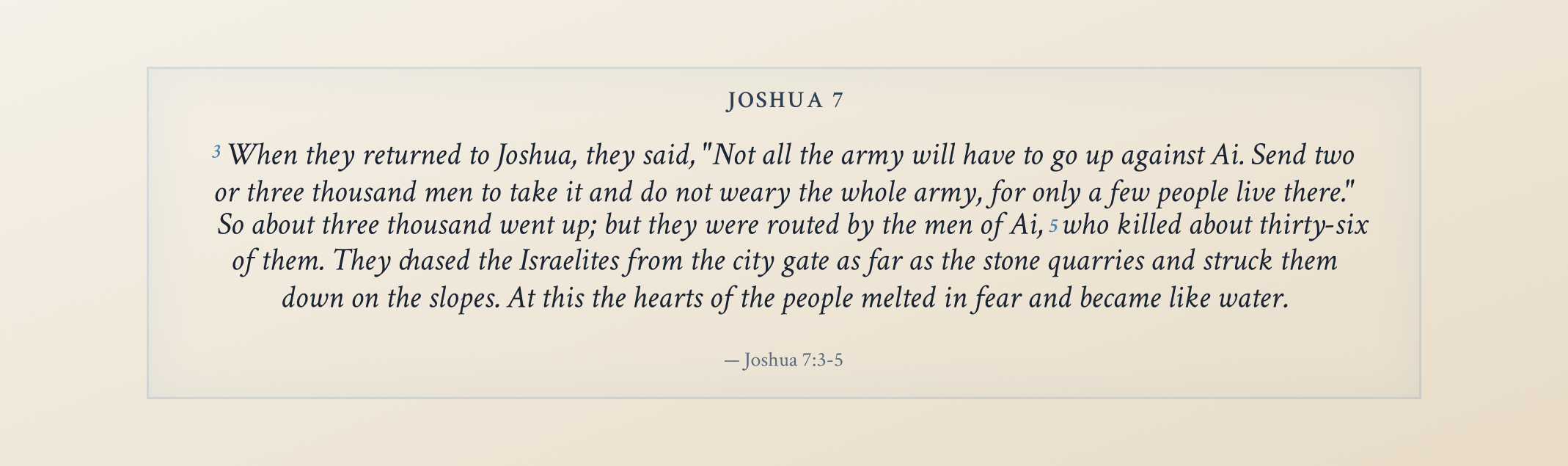
After the Battle of Jericho, the Israelites decided to take over a new town called Ai – yes, Ai. They had just conquered Jericho and didn’t see the need to bring all their soldiers. They thought God would want them to continue conquering new lands - it would be like defeating New York City and then taking on Cooperstown. Easy victory.
Their sin was both in disobedience and in taking some of the devoted things God had forbidden.

The story plays out where they are routed by Ai. Thirty-six of them are killed, and they run back and cry out to the Lord in frustration, thinking it was His fault. But God corrects them, revealing their sin and reminding them who leads the battle.
In the same way, we can be tempted to rely on AI rather than consulting the Lord first. He longs to hear from us before we make decisions. His heart is that we seek Him, wait on Him, and obey. Rather than asking ChatGPT, we should be asking the Lord. The order matters as well as our intentions.
The second passage that comes to mind is 2 Corinthians 10, from the New Testament:
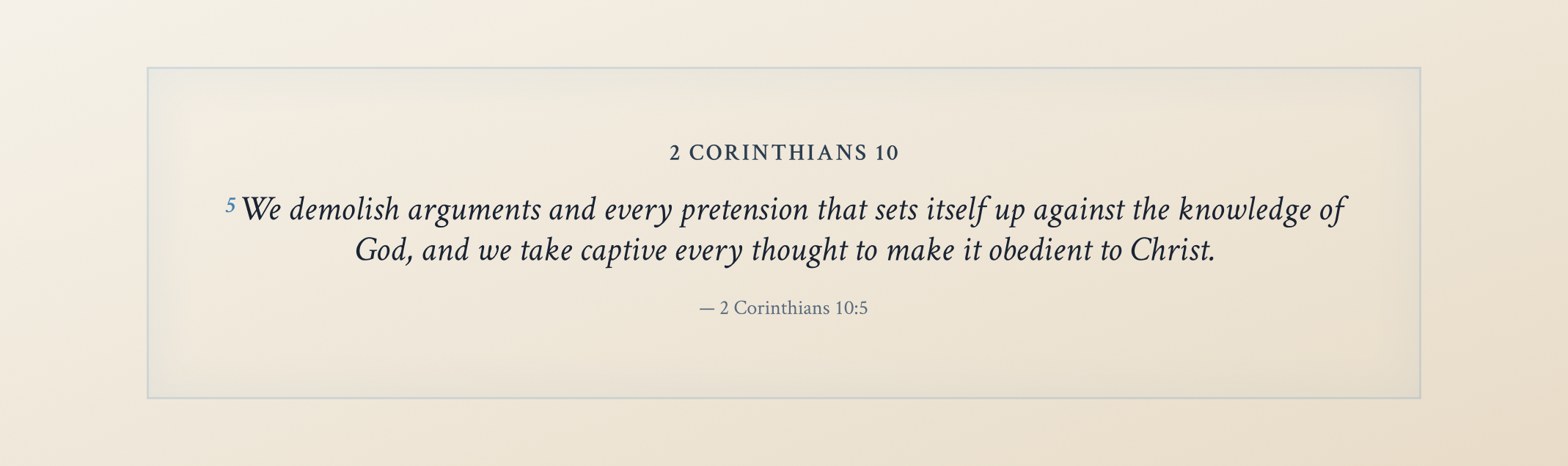
As I read it, the Apostle Paul is urging us to understand how we process information – and what we allow to influence us. In the context of AI, that means we must guard our minds effectively, distinguishing between interpretation of data and the spiritual act of seeking the Lord.
God has designed us with two complementary ways of engaging with reality - often described through the metaphor of the “left” and “right” brain. While we now know the brain works as a whole, this distinction helps us see the difference between analytical, step-by-step processing and relational, big-picture awareness.
My sense is that AI can serve as a powerful tool for “left-mode” tasks: organizing data, conducting research, and solving technical problems. These are functions of logic and information.

However, we must be cautious about letting AI encroach upon the “right-mode” of the brain - the realm of love, worship, and ultimate purpose. Seeking spiritual direction, replacing human friendship, or letting an algorithm guide our deepest moral decisions risks outsourcing our humanity to a machine. We should treat AI as a tool for technical work, while guarding the sacred, relational work for the Holy Spirit, Scripture, and the embodied community in the Church.
Every era of innovation presents both opportunity and temptation. The opportunity is to use new tools to spread truth, serve our neighbors, and reveal God’s beauty in fresh ways. The temptation is to idolize the tool itself or to let it replace our dependence on God. This temptation is uniquely present with artificial intelligence.

Our challenge is to recognize this while making the most of this amazing tool. God’s plan for his people has always involved technology. He equips His people with resources – roads, printing presses, the Internet, now AI – and asks us to steward them faithfully.
As we enter this next era of innovation, may we seek His will before efficiency, His voice before automation, and His presence before any prompt. If we want to make the most of the world’s AI agents, we must always remember that we are God’s agents first.
Mark Johnson is a co-founder and partner at Michigan Software Labs, where they help organizations design and build digital products that serve people and strengthen companies. He is a frequent contributor to Forbes and Fast Company and recently delivered a TEDx talk that has been viewed more than one million times. Mark serves on the boards of the Economic Club of Grand Rapids, Holland Home, and International Aid, reflecting his commitment to leadership, service, and the common good. He and his wife live in West Michigan and are the grateful parents of four daughters.

