


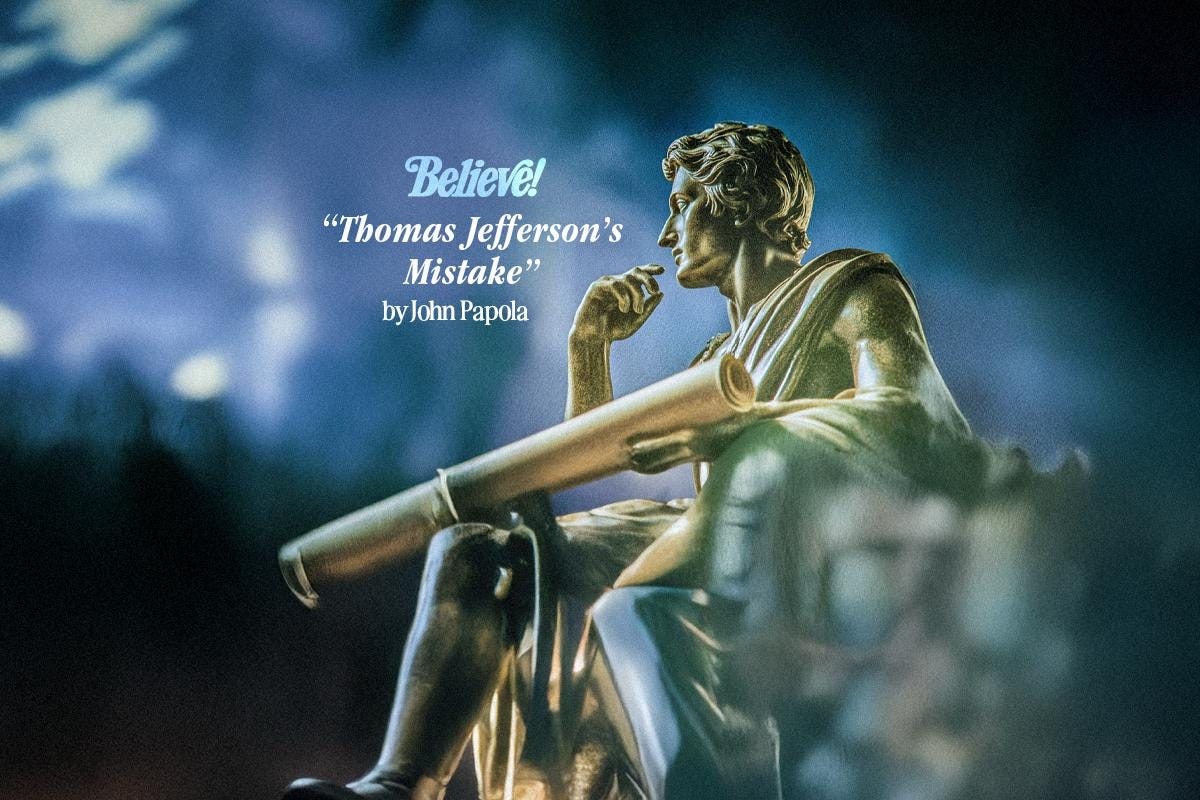
As we head into the 250th anniversary year of our Declaration of Independence, it’s worth revisiting another revolution that looms surprisingly large in our modern consciousness: the French Revolution. A comparison of the two events, and their underlying impulses, offers important lessons for our country today.
Thomas Jefferson, author of the Declaration and our ambassador to France at the time, was a serious Francophile who supported their revolution well past its disastrous expiration date. One can understand why. The French had supported Americans in our battle against the British Crown. Their revolution was inspired by our own. Their rallying cry of “liberty, equality, and fraternity” seemed to echo Jefferson’s “life, liberty, and the pursuit of happiness”. And yet where our revolution gave birth to the longest standing constitutional republic in human history, theirs descended quickly into a reign of terror, and soon after, a return to dictatorship under Napoleon.
The question is: why?
Understanding the answer just might help us avoid repeating their mistakes at a time where more and more Americans across our politics are losing faith in our system. At the core of these two revolutions were two very different visions of the nature of man and government.
America’s founders held to what Thomas Sowell calls a “constrained” vision of man. We are flawed, fallen creatures, prone to self-interest, and necessarily limited by the realities of time, space, and our own minds. No political system could, itself, straighten this crooked arrow of man. Utopia could be found in heaven alone. For this reason, John Adams observed, “Our Constitution was made only for a moral and religious People. It is wholly inadequate to the government of any other.”
With these essential insights rooted in a sound reading of history, the English tradition, and Christian morality, our founders pursued a revolution that was fundamentally conservative. We threw off the chains of distant British control so that we might conserve a society that was born in pursuit of religious liberty and was flourishing in relative political and economic freedom–a freedom that would ultimately expand to every American rooted in the principles of the Declaration from the very start.
The same constrained vision and values that gave rise to our uniquely American political system which separates powers to check each other with competing ambition, and decentralizes political choice through federalism so that people can ultimately vote with their feet, also powers the free enterprise system that’s made America the most materially successful nation in human history.
There is no singular utopian solution to our problems. There are only trade-offs and marginal improvements towards a better world.
The Frenchmen who came to dominate their revolution, the Jacobins, had a more “unconstrained” vision of man inspired by the proto-romantic philosophy of Jean-Jaques Rousseau. He believed that men were born free, equal, and lived in peaceful plenty in a state of nature. Returning to this “state of nature” demanded that they throw off the chains of modernity and tradition.
With the spirit of Rousseau animating them, France’s revolutionary project quickly expanded beyond its early calls for constitutional reforms to demanding the wholesale overthrow of society itself. This was their moment to unshackle themselves of the chains of tradition and be born again in an enlightenment-driven utopia on earth. Notre Dame would be recast as the “Temple of Reason”, replacing Christianity with a new atheist creed. The old social hierarchies would be leveled by the guillotine.
Utopia, it turned out, was not an option as the French found out good and hard as their revolution collapsed into disorder, chaos, and ultimately the return of totalitarian rule by their new emperor, Napoleon Bonaparte, just a few short years later.
We aren’t blank slates to be molded by utopian central planners. As Ayn Rand once quipped “We can ignore reality. But we can’t ignore the consequences of ignoring reality.”
Unfortunately for us today, these lessons of history are remarkably hard to preserve. Rousseau’s utopian vision would be rehashed, largely in France, by subsequent socialist thinkers and given its most popular reformulation by Karl Marx, who would declare “you have nothing to lose but your chains” in his Communist Manifesto against the backdrop of yet another wave of failed revolutions in 1848. The subsequent revolutions declared in his name, from the Bolsheviks to Mao Zedong to Pol Pot to Fidel Castro, would prove even more nightmarish than the Reign of Terror led by Robespierre.
Today, in the United States, as we approach our singularly successful, conservative revolution’s 250th birthday, we are in danger of succumbing to this siren song of utopia ourselves.
As I write this, we are less than a month away from a radical, utopian Jacobin, Zohran Mamdani being elected mayor of our largest city, and financial capital. We’ll see how long it retains that position if he wins. The movement of new Jacobins supporting Mamdani, like their French forebears, don’t hide their desire to abolish the family, abandon Christianity, seize the means of production, and usher in communism.
And as with all of the prior utopian revolutions, the leaders of this new Jacobin movement aren’t the proletarian working class they claim to represent. No, they are the relatively well-off, over-schooled, excessively credentialed, envy-powered children of the aristocracy. The elite. Here too, Mamdani is their perfect avatar: the elite son of an acclaimed filmmaker, who attended shockingly expensive private schools, yet has never held a meaningful job in the voluntary service of other people in his young life.
What makes our moment especially dangerous is that today’s America looks a little too much like revolutionary France. And its source is, ironically, these very same Jacobin characters. After a century of “progressive” political domination, the constitutional structures built to constrain power by our founders have been twisted to the point where our presidents can act like a king and the executive branch with its sprawling administrative state can intervene into even the tiniest details of American life.
The decentralized politics and civil society that Alexis de Tocqueville noted in his great work Democracy in America has given way to a centralized rule by decree that echoes the French crown. The privileges and favors given to the politically connected has indeed created a new economic aristocracy that should be rightfully condemned. President Trump’s unfortunate zeal for getting the government in bed with big business through equity stakes and special deals only strengthens the legitimate criticisms of our new Jacobins, even if their solutions would take us out of the frying pan and into the fire.
And so today we face a choice that’s both old and new: we must confront a domestic political and economic system that is in need of significant reform from within, without allowing our new Jacobins to unleash chaos in pursuit of a utopia once again. We must rediscover the virtues and moral foundations that made a limited constitutional republic like ours possible in the first place. We must make the moral case for limited government, voluntary exchange, and peaceful cooperation in civil society as the best path forward. Because there is no alternative to be found in the history of this planet and utopia is no closer to reality on earth in 2025 than it was 250 years ago.
John Papola is the co-founder, CEO, and creative director of Emergent Order, a creative studio based in Austin, Texas. He also hosts the hit YouTube series Dad Saves America.

May I recommend chapter 4 in Hayek's "The Constitution of Liberty" that goes through the differences between British and French liberalism. For those who read French, Pierre Rosanvallon writes about this in "Le sacre du citoyen", a long, complex but highly rewarding book.
You are the best.