


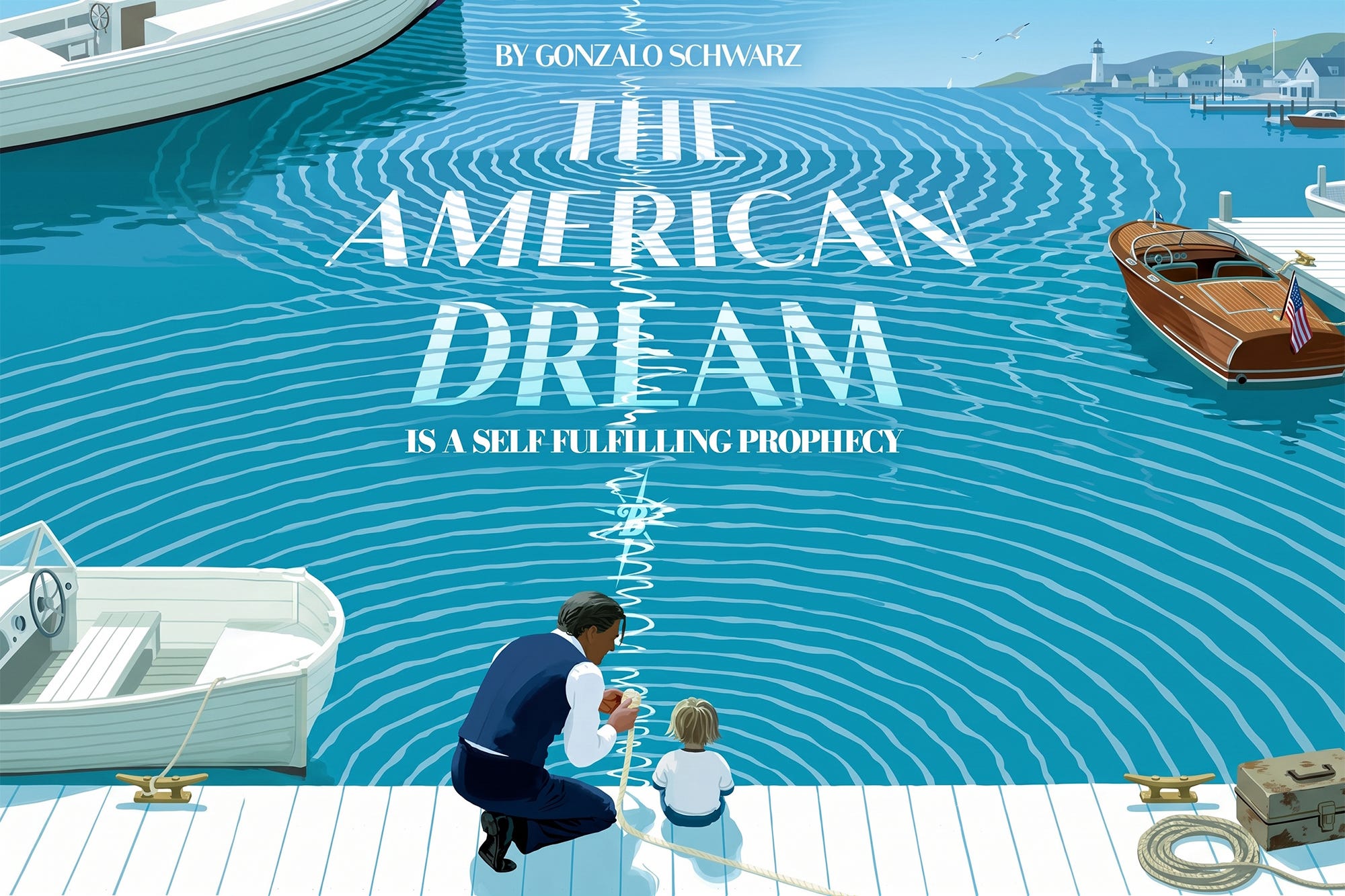
When I moved to this country almost 20 years ago, I fell in love with the American Dream. I fell in love with it so much that I’ve devoted my life to “selling” the American Dream—to paraphrase Rich DeVos’ great speech “Selling America” (which he delivered throughout the 1960s)—by founding a think tank dedicated to inspiring more hope in this incredible cultural ethos.
The founding father of the American Dream, James Truslow Adams, defined this concept 100 years ago in The Epic of America (1931):
[The American Dream] is that dream of a land in which life should be better and richer and fuller for every man and woman, with opportunity for each according to his ability or achievement . . . . It is not a dream of motor cars and high wages merely, but a dream of a social order in which each man and each woman shall be able to attain to the fullest stature of which they are innately capable, and be recognized by others for what they are, regardless of the fortuitous circumstances of birth or position.
Towards the end of the great “Selling America” speech, DeVos quotes Thomas Wolfe’s similar theme:
So, then, to every man his chance, to every man, regardless of his birth, his shining golden opportunity, to every man, the right to live, to work, to be himself, and to become whatever thing his manhood and his vision can combine to make him—this, seeker, is the promise of America.

The promise of the American Dream is also at the core of the United States’ founding document, the Declaration of Independence: “We hold these truths to be self-evident, that all men are created equal, that they are endowed by their Creator with certain unalienable Rights, that among these are Life, Liberty and the Pursuit of Happiness.”
The unique ethos of the American Dream is a treasure that should be cherished. Two economists and Nobel laureates, Joel Mokyr and Edmund Phelps, recognized the importance of culture for human progress and mass flourishing, especially in Europe from 1400 to 1800. New cultural attitudes and institutions ushered in by the Renaissance, Enlightenment, and Industrial Revolution led to greater freedom, innovation, and paths to human flourishing. I would argue that no place has done a better job of fostering and embodying those cultural environments than the United States, where the American Dream has been woven into the social fabric of a country.

Despite the incredible success of the American Dream, it is never without its critics. Recently, American journalist David Leonhardt argued that the American Dream is in decline, while other pundits suggests that the American Dream is better found outside the U.S. Moreover, politicians on the left and the right motivate their base by casting doubt on the Dream and offering to be its “saviors.” You can find criticism of the American Dream in all kinds of unexpected places, like a Captain America comic or a Green Day song. Truslow Adams himself acknowledged this pessimism when he said, “It is a difficult dream for the European upper classes to interpret adequately, and too many of ourselves have grown weary and mistrustful of it.”
Despite the critics, research by my organization, The Archbridge Institute, shows that the American Dream is alive as a unifying and aspirational force after 250 years.
We have conducted a survey of the American people for the past seven years, and the results show the American Dream is resilient. Despite concerns about rising economic challenges, the majority of people continue to believe in the American Dream. Almost 7 in 10 Americans believe they have either achieved their Dream or are on their way to achieving it. Most Americans are optimistic about this Land of Opportunity and feel that the American Dream is about the journey and not just the destination. Some 8 in 10 Americans agree that the Dream’s defining features are freedom and a good family life, while only a minority focus on material things like owning a house or becoming wealthy. More than 6 in 10 define “equality” as having equal opportunity and fairness before the law; only 4% view equality as a measure of equal outcomes.

Americans believe that immigration has been and continues to be a building block of our nation and that the character virtues of honesty, integrity, personal responsibility, and work ethic are essential to the American Dream. In his speech DeVos mentions, “A typical American can be depended upon, is trustworthy, honest, and carries out his responsibilities. That is the true American that I know.”
Are there challenges past and present to the American Dream? Yes. But the American Dream is resilient precisely because it is about embracing and overcoming challenges, at an individual and societal level. The American Dream inspires us to overcome barriers. In addition to sharing the data, we need to “sell” the many amazing stories of Americans who achieved their Dream, regardless of where they started, such as Rich DeVos, Madame CJ Walker, Walt Disney, Sam Walton, among millions of entrepreneurs, the Founding Fathers themselves, and civil right leaders like Frederick Douglass and Martin Luther King Jr. All of them overcame barriers on their way to achieving their American Dream and enabling others to do the same.

And that resiliency has allowed the American Dream to be the fuel that drives the progress of America and its people for the past 250 years. When we exaggerate the death of the American Dream, make it a national hobby to criticize America, or take it for granted, we risk making the demise of the American Dream a self-fulfilling prophecy. Selling the American Dream is selling America and the resilience of the American Experiment for the next 250 years.

