


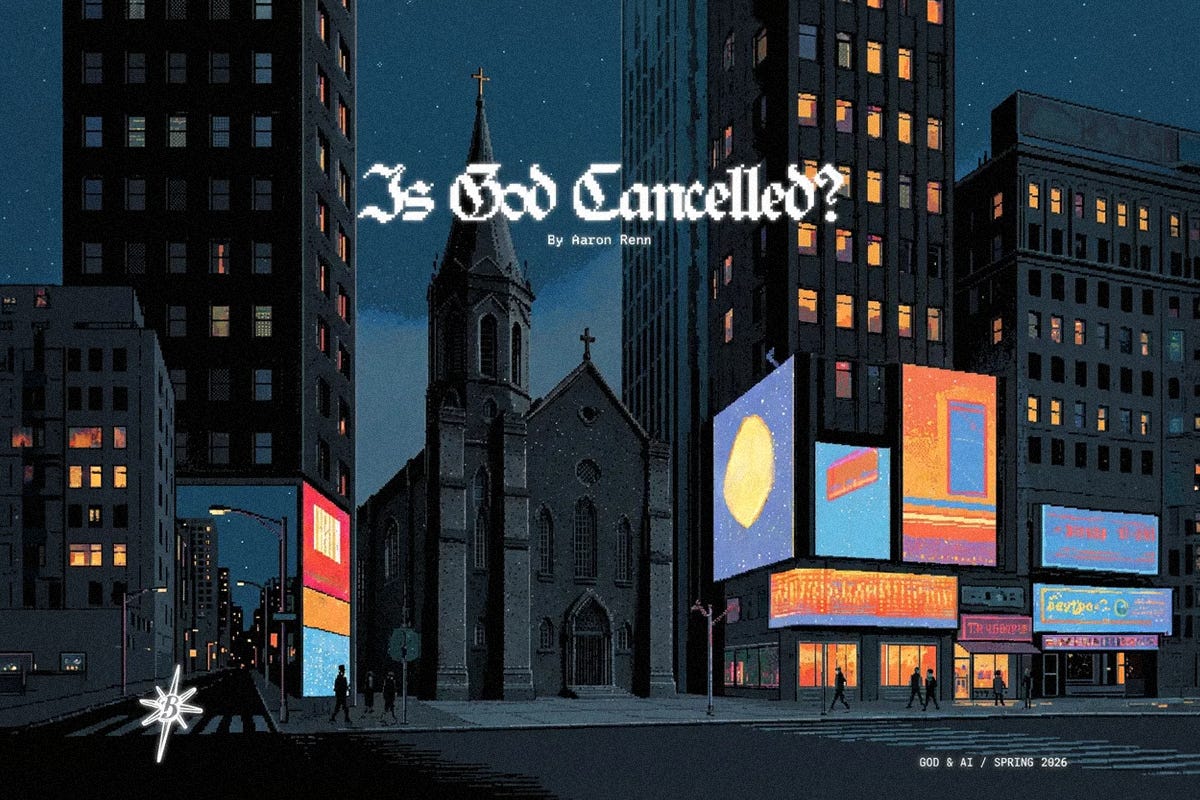
Aaron Renn, one of our frequent contributors, recently released an excellent book: “Life in the Negative World: Confronting Challenges in an Anti-Christian Culture.” Technology is certainly one of those challenges, and while it’s not the focus of the book, Aaron’s wisdom directly bears on the AI debate.
AI has given rise to a new era of negativity—to the pessimism that even as technology advances, the human experience will suffer. Many people of faith are especially concerned, given AI’s lack of a moral foundation and reflection of the secular society in which we live.
Whatever the case, AI poses challenges that must be confronted, and we hope Aaron Renn’s book helps you find the path forward. Please enjoy the book’s introduction—and if you like, buy the whole thing!

In 2014 the Benham brothers, Jason and David, were sitting on top of the world. The Benhams are the identical twin sons of an alcoholic bar owner turned pastor and noted pro-life activist. Raised as Christians, the brothers played baseball at Liberty University and were later drafted at the professional level. After their brief careers in the pros, they planned to go into traditional nonprofit ministry before realizing they had just as much opportunity to advance mission through for-profit work. They started a successful real estate company, which in turn led to a dream opportunity: the chance to have their very own home rehab television show on HGTV. The show was called Flip It Forward.
This dream turned into a nightmare for Jason and David after activists attacked them for their Christian beliefs. Labeling them anti-Islam and anti-gay as well as anti-abortion, these groups pressured HGTV to drop the Benhams. HGTV canceled their show in mid-production, even though the crew said the brothers were “extremely genuine, nice guys” and didn’t push their religious beliefs. The firestorm of controversy saw the Benhams and their show’s cancellation featured across major media outlets: ABC, CBS, CNN, MSNBC, the New Yorker, TMZ, the Hollywood Reporter, and more.
In 2000 Dave Cover and his team planted The Crossing church in Columbia, Missouri, home to the state’s flagship University of Missouri. The church’s name reflected the team’s hope to build bridges to those who were not Christian, or who held negative stereotypes about the faith. Outreach to the community was one of their core values.

One way they did this was sponsoring a local film festival called True/False. While this was a secular festival, the church thought the films featured were asking the right questions about the human condition and what was wrong with the world. Though some people in both the festival organization and the church were initially apprehensive about working together, they decided to move forward.
The Crossing ultimately became one of the festival’s biggest sponsors, and this unique relationship between a Bible-believing evangelical church and a secular progressive film festival became nationally known. It was positively featured in the New York Times, which highlighted how the two groups were able to work together while disagreeing on some matters.
Then in October 2019, a sermon at The Crossing affirmed that there are only two genders, saying, “Gender is not a social construct. Men and women are foundational to God’s plan. God is not pleased when we blur genders.” This sermon caused a major controversy in the Columbia community. As the church stood by its position, institutions in town came under pressure to drop partnerships. The True/False Film Fest cut ties. An art gallery did likewise. A church that had worked hard never to offer gratuitous offense suddenly found itself a pariah in parts of the local community it had been trying to reach.
Though the Benham Brothers and The Crossing share an evangelical commitment to the gospel of Jesus Christ, their styles and strategies for taking it into the world were radically different. The Benhams came from a culture-war background. The Crossing emphasized cultural engagement. Yet both experienced the same fate. Regardless of their approach, the world was not willing to accept their beliefs.

The fact that Christians like these are at risk of being ostracized for their beliefs reveals that we’ve now entered a new and unprecedented era in America — one I call the negative world. For the first time in the history of our country, orthodox Christianity is viewed negatively by secular society, especially by its elite domains.
This shift poses a profound challenge to American evangelicals and their churches and institutions. It also helps explain the turmoil within the evangelical world and why some believers have “deconstructed” their faith.
This book is about the shift to the negative world, what it means, and how to live in this new reality. I describe the changing relationship between culture and Christianity over the past sixty years, tracing the fall of Christianity’s status from being softly institutionalized in the 1950s to increasingly seen as a threat to society’s institutions today. I also examine the strategies evangelicals used to respond to this decline and how those approaches have changed — and sometimes deformed — under new pressures.
I argue that fresh strategies must be developed to respond to the challenges of the negative world. I do not pretend to offer a detailed road map. We are in new territory with no map, and the landscape is constantly changing. We must explore and find a path forward under conditions of uncertainty and discomfort.
I come to this from a unique background. I spent nearly two decades in technology and management consulting, primarily with the global firm Accenture, advising Fortune 500 companies on navigating rapidly changing business environments. I later applied those skills to urban policy research as a senior fellow at the Manhattan Institute. My insights have appeared in outlets including the New York Times, the Wall Street Journal, The Atlantic, and The Guardian.

I also have experience across different parts of evangelical America. I grew up in rural Southern Indiana attending fundamentalist Pentecostal churches with a culture-war orientation. As an adult, I have mostly lived in cities like Manhattan and Chicago and attended Presbyterian churches oriented toward cultural engagement. I therefore understand both major camps in evangelicalism — and their strengths and limits.
I provide in this book a framework of the three worlds of evangelicalism — the positive, neutral, and negative worlds — originally developed in 2014 and later published in First Things. The framework describes the stages of Christianity’s declining social status in America over the past sixty years.
I also describe three evangelical responses: culture war, seeker sensitivity, and cultural engagement. I then offer considerations for life in the negative world across three dimensions: personal, institutional, and missional. The goal is not to dictate actions but to provide ideas Christians can use to make thoughtful and prayerful decisions.
I am neither a pastor nor a theologian. This is not primarily a work of theology but of cultural analysis and strategy. It addresses the social and political context in which pastors and theologians must apply God’s Word today.
While others may benefit, this book is written primarily for evangelicals in America. Whether or not you share that identity, I hope it helps you navigate the new world we inhabit — the negative world.
Let’s begin by looking at how we got here.
Taken from Life in the Negative World by Aaron M. Renn. Copyright © 2024 by Aaron M. Renn. Used by permission of Zondervan. www.harpercollinschristian.com

