


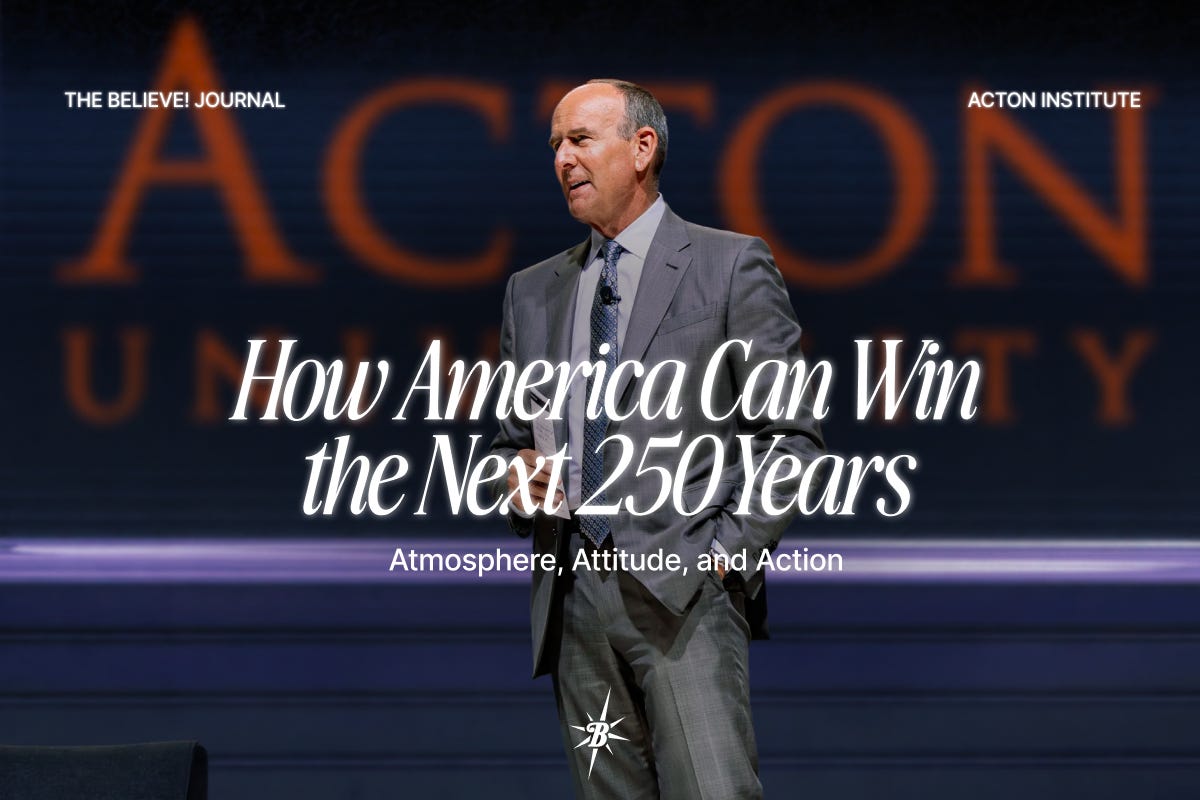
This summer, I had the privilege of speaking at Acton University to a global audience who believes, as I do, that faith and free enterprise are the best formula for human flourishing. As America approaches its 250th birthday, I wanted to reflect on the ideas that set our nation on its course: that our rights come from God, not from kings or central planners; that we are citizens, not subjects; and that these self-evident truths, as powerful as they are, are not self-perpetuating. Drawing again from my father’s wisdom, I returned to a simple framework that he called Atmosphere, Attitude, and Action. Atmosphere is the people and ideas you surround yourself with. Attitude is the emotional toolkit for making the best of any situation. And Action is how we make use of our innate talents to shape the world around us. These I believe were key to taking America from the promise of Plymouth Rock to the superpower it is today, and will be key in holding back the rising tide of socialism, communism, and all the other -isms that threaten to lock away its untapped potential forever. You can listen to the full talk—or read the complete transcript—below.
Believe! Acton University 2026 Plenary with Doug DeVos - Full Transcript
It’s a tremendous honor to be here with this incredible group. To the entire Acton team — thank you for giving me this opportunity. I looked at your schedule and I’m not sure how I made the cut. When I listen to Fernando speak, I think, what am I doing up here? He did a lovely job articulating the things that we all care about so deeply. I want to talk about the ideas of faith and the unlimited potential that people have, and how free markets and free enterprise intersect to help people realize that potential. We have an issue that faces all of us: will we be able to continue? The future is unknown. What sort of future is going to be created as we move forward together? We’re here because we have a particular point of view and there’s a future that we would like to see created. So I want to walk through how we might think about the things we need to do as we go forward.
As a host to so many from around the world, I have to do a little red, white, and blue. We’re celebrating 250 years of our country since our founding. So I have to start with the Declaration. The ideas that were part of it — earthshaking ideas, founded on biblical principles given to us by God — came together in a document that crystallized a course for a new nation.
The ideas that come through so clearly: these self-evident truths, that we were created equal and that we have these unalienable rights. The whole idea is to take these rights and these opportunities — life, liberty, and the pursuit of happiness — to not just feel good, but to be good, to live a life of virtue, and to find our way forward. When I spent time at the Constitution Center, there was what they called the drafting table — a chance to go behind the scenes of all the work done before the Declaration was finalized. What was in? What was out? What was changed along the way? And in that process, there’s one part where you see a word that’s a little different, smudged, more boldly written. There’s always been a question about what the change was. The original word was “subjects.” They changed it to “citizens.”
Think of the difference one word can make. Think of the difference one thought, one idea expressed, can make — the difference between being a citizen or being a subject. What that says about our rights coming from God and not from kings. Each and every one of us in this room, each and every one of us in this world, can be viewed in this way. It’s a powerful change.
We’re going to be celebrating the 4th of July at 250 years. But a number of Fourth of Julys ago, Frederick Douglass gave his speech, “What to the Slave Is the 4th of July?” He spoke about the fact that he wasn’t included in that declaration at that time. But he saw in it the promise and the hope, and he articulated this powerful phrase: the principles contained within it are our saving principles. Stand by those principles. Be true to them on all occasions, in all places, against all foes, at whatever cost. What a great challenge for each and every one of us.
Now, let’s take these principles and think about how they were put together in the declaration and in our country. We were fortunate — it was a point in time when so many of these ideas were being formed around the world, and we were able as a country to put them in one place, to create an experiment, a startup if you will. As a business person, I love the idea of startups. Maybe the United States had that benefit. And in fact, that’s the same idea my father and his business partner Jay Van Andel put into Amway — the idea that anyone from anywhere could achieve anything. They named it Amway: the American way.
We’ve been building the business for nearly 70 years. But there’s an interesting piece here. Once the business started, there were a lot of people from Canada saying, “Hey, this could work up there.” And so Dad and Jay had a dilemma: do we call the business Amway in Canada? Maybe we should call it Canway. They actually had that discussion. As you heard, we’re now in 100 countries and territories around the world. It would have been very confusing had they gone down that track.
But they had an idea. They said, “It’s really not confined to our country. We believe that people all over the world share these ideas. These ideas really resonate and connect with people globally.”
I’ll take you to 1979 in Malaysia. I had a chance to grow up in the Amway business and I made this trip while I was in high school. We’d been in Malaysia for about three years at that time and were having a convention. Business had started very successfully with a few thousand people coming. And when Dad visited, he was able to get a meeting with the prime minister of Malaysia — a really big deal. As he reflected and told us about it, he said the prime minister congratulated him and then said, “It’s interesting that things are going well for you, because our country is struggling right now. The greatest natural resources of Malaysia are copper, tin, and oil, and all their prices are depressed on the global market. But here you are with thousands of people at this event. You’ve been growing for three years. What’s your secret?”
He said, “Well, Mr. Prime Minister, you may believe the greatest natural resources of Malaysia are copper, tin, and oil. But in Amway, we believe the greatest natural resources of Malaysia are the people of Malaysia. And in our business, we invest in People.”
What a powerful thought. We invest in people — just like Fernando, just like each and every one of you. So what do you get when you combine the principles that we should fight for at any cost with that connection to people? What can happen when you start to apply those things at scale?
What happens is the hockey stick of human history — total GDP throughout history. It seems pretty bad there for the first 1,800 years. No matter your station, life was pretty miserable in virtually every way. You may have been royalty, but you still died young, your children died, you were living in difficult conditions. But something happened. These ideas came together — not just in the United States, but in places around the world. And these ideas continue to generate wealth and opportunity and prosperity and human flourishing.
It was those principles and our founders that enabled people to go to work and create the things that they created. We talk about this at our headquarters. We have a display that was in the World’s Fair in 1964 in New York — the Ten Pillars of Economic Wisdom, which you would walk through to reach the Hall of Free Enterprise. Dad and Jay loved the display and brought it to Amway headquarters. It’s still there today. The tenth pillar articulates this idea amazingly well: “The productivity of the tools — that is, the efficiency of the human energy applied in connection with their use — has always been highest in a competitive society in which the economic decisions are made by millions of progress-seeking individuals, rather than an estate-planned society in which those decisions are made by a handful of all-powerful people, regardless of how well- meaning, unselfish, sincere, or intelligent those people may be.” Nobody can make the right decision for you better than you.
Now, it’s easy to look at that hockey stick and say, “Wow, it’s just going to continue.” But as Benjamin Franklin said when asked after leaving the constitutional convention, “What have you given us?” His answer: “A republic, if you can keep it.” And that’s our Challenge.
These principles — and I know not all of us are from America, this is a global audience — but we share together the principles and ideas that have created an environment of human flourishing like the world has never seen. We have to keep these ideas going forward, because we know there are examples of empires that have gone away and failed: the Romans, the Mayans, the Incas, the Greeks, the Egyptians. Hundreds, sometimes thousands of years — but for some reason, they didn’t continue. There’s no promise that things will continue like this for us or for our world either.
Is the glass half empty or half full? We know the risks are coming back around. Secularism wants to come. There’s a large group of people that want to remove God from our society, that think God is too limiting. And if our rights come from God, then obviously the rights of humans don’t matter much to them. It’s nothing new. Some of you have seen that in Europe in World War II. The movie about Dietrich Bonhoeffer — how he stood up to those elements where leaders want to create themselves as gods and replace God. There are elements of that that continue today. When there’s no God, there’s no hope. We know that in our lives.
And then you have socialism and communism back again. Round two. Like the sequel, right? Comes back. New players, new actors, new things. Same old script. No innovation. No creativity, no free enterprise, no wealth creation. New ways to say it, new ways to sell it. New customers every year, new generations coming through. As we talked about earlier, in the declaration these truths are self-evident. But that doesn’t mean they’re self-perpetuating. It doesn’t just go on unless we — and others with us — help it go on. That’s what we have to do. Sometimes common sense isn’t so common. Sometimes those selling socialist ideas seem pretty attractive to people. We have to continue expressing our beliefs. And that’s what my father did when he wrote Believe about 50 years ago — an expression of what he believed, lived every day. So what I want to talk about in the time I have left is how we are going to live it every day. What do we do to take this forward? How do we make sure our beliefs drive our behavior? How do we ensure that we feel strongly enough about what we believe that we’re willing to take the risks necessary to think and act differently? What innovation, what creativity are we putting into making sure these ideas connect with more people? How do we connect the dots better? How do we continue to reflect our belief that God has granted us incredible love and gifts and potential — and express that to other people? Because God loves us, we can love others in the same way.
So I want to put forward a framework of three A’s: atmosphere, attitude, and action.
Atmosphere
We are here in this place and this has been curated. This event, this university has been thought through. The Acton team has put together this program so that when you get here, you know you’re in a place to move forward. You know you’ve found the right spot. That’s why churches look the way they do around the world. When you go into a place of worship, you stop in awe and feel the presence of God in a new way. Put yourself in a place where the atmosphere just rolls over you — whether it’s La Sagrada Familia in Barcelona or St. Peter’s Basilica in Rome. Places that take your breath away, that put you in a different position. There’s a culture. There’s a family. There’s an Expectation.
In business, we work to create culture every day. At Amway, we talk about freedom, family, hope, and reward. These were the things my father and Jay Van Andel put into the business. When we would hire executives and they’d walk into our headquarters building — we have those words written there — we’d say, “If you walked in and said, ‘I’m home,’ well then, let’s keep talking. If you walked in and said, ‘These people are nuts,’ it’s been nice to know you. Move on.”
What are the things you can do to create a place, create a culture, create a sense of feeling, a sense of family, a chemistry that’s necessary to bring people together as a team? Whether it’s Brazil or Scotland or any other team, you can have great individuals, but if they don’t play together as a team, it’s not going to work. It takes work. I want to encourage you to think about the atmosphere you place yourself in. Are you in a place that helps you grow, where the culture helps you thrive? Or are you in a place that holds you back?
We always found in the Amway business that people would get excited at the meeting and then go home, and their brother-in-law would say they were crazy. They had a decision to make: either keep listening to their brother-in-law, or come back to the meeting and do something different. We have to make those decisions for ourselves. And we can create environments for others. We can create the place of where we want to go.
Attitude
Atmosphere is where you are, but attitude is what you think. What’s in your mind? You’re talking about dreamers and doers — people that are thinking of new things all the time, who won’t let no stop them, who see the opportunities and not just the barriers. The impact that people like this have on our lives is immeasurable. My father had heart disease for many, many years. He had bypass surgery, a heart attack, and ultimately got to a place where he was in need of a heart transplant. Nobody would take him in the US. He was too old, too sick, had too many challenges. There was one doctor in London who would consider him. The chances were slim, but he went anyway. He and Mom did. And every morning in their devotions, they started with Philippians 4: “Rejoice in the Lord always. I say it again, rejoice.” Their attitude was always positive. “Here’s what we’re going to do when we get out of here. Here’s where we’re going to go. I’m going to see my children, my grandchildren. I want to see them get married. I want to see them graduate. I’ve got something to live for.” The doctor said, “You’ve got to have something to live for because it’s going to be hard.” And that’s what he chose.
How do we think about things? What does that passage end with? “Whatever is true, whatever is noble, whatever is right, whatever is pure, lovely, admirable, excellent, praiseworthy — think about such things.” We all know people that gripe all the time and can find the half-empty side of the world. You need that sometimes, to have somebody give you a dose of reality. But when you’re always thinking negatively, it’s going to continue to hold you back.
I had an experience when I was in third or fourth grade — I didn’t think I could make friends, struggling at school. My father would not accept that. So he took me to school one day and gave me a pep talk the whole way: I was capable of making friends, I was a good kid, I could go out, introduce myself, say something, go meet somebody. As he let me out of the car and I was walking up the sidewalk to the school, he had the window down, looking at me: “Go get him, Mr. Happy.” I still remember it. I can still see him. So I gave it a shot. Think positively. Think about the right side. Manage your thoughts well.
Action
How do we take all these things and do something? In the Amway business, it’s a simple business opportunity. But Rich and Jay just believed that if you gave somebody an opportunity, they’d do something with it. More and more people around the world complain, “I don’t have an opportunity, I don’t have a chance.” Well, here you go. There are a lot of people who reject it and a lot who think our business is crazy, but a lot of people who saw it as an opportunity for them and did something with it. They’ve done great things. They’ve built big businesses. They’ve helped a lot of people — because they saw an opportunity and they took action.
At the end of the day, that’s what we need to do. We’ve been here, talking, thinking, communicating, building relationships, doing so many wonderful things. But at some point you’ve got to do something. You’ve got to take that step. Take that risk. Risk failure. Make a mistake. Learn. Try again. Chris talked about some of the sailing I’ve done. I have no business sailing at the level I’m trying to do it. Sometimes I have no clue. But I tried it anyway. I lost a lot. But work hard enough, learn enough, meet enough good people — I’ve won a few times, too. And that was a great journey.
Whether you’re walking onto the field, or standing up in front of an orchestra, or like my youngest daughter who is a dancer — on a big stage, dressed up, all alone, waiting for her music to start. Scared the daylights out of me. I wouldn’t have done that. But there she is, getting in the game, taking the risk, taking that step, taking the action to move Forward.
My father used to talk about a quote: “A great tradition can be inherited, but greatness itself must be won by each of us.” Whether that’s as an individual, as a team, as a country, or as a generation — the future has to be won by each of us. We have to get in the game, take steps, take risks, be willing to fail, learn, get back up, do it again, keep moving forward.
So I’d ask you: can we do this? Of course we can. And I want to share a quick story about an example, because you’re sitting in this hall and in this city where we went through this process about 50 years ago.
President Ford was running for re-election — our favorite son, an amazing person. Never elected vice president, never elected president, but served at one of the more difficult times in our nation’s history. Served with dignity and honor and integrity, did what was right for the nation, held us together, ran a tough race, and lost. In Grand Rapids, after it was done, we wanted to give him a parade, celebrate all that he’d done. And the Secret Service said no. The parade route was too risky. All the buildings were vacant. Nobody was there. There was only one building on the parade route that was occupied. Shooters, risks everywhere. What a blow.
Well, Grand Rapids rallied. Volunteers came together, and we found a way to do that parade. We found a way to celebrate him as best we could. But the message was clearly delivered: we’ve got a problem. Our city’s in trouble. What are we going to do about it?
A few people got together. They didn’t like the feeling that we were behind. They said, “We’re going to do something about it. We’re going to take action.” People like Peter Seia, my Dad, Jay — the Cooks, the Kennedys, the Heisings — all these names in our community that came together, building on the legacy of the generations that had gone before, said we’re going to do something different. And I had a front row seat. I was young. I had a chance to watch this happen in Grand Rapids, in our city.
I remember being at home seeing the plans of the hotel that was going to be built. And we got involved with a project — it wasn’t something Amway did, but we had helped find a developer to build a building right down the road. And the developer didn’t quite have the same value system as the rest of Grand Rapids. Kind of did it on the cheap. Didn’t work so well. The plumbing — I don’t know if you know about big buildings, but plumbing is pretty important for tenants. And he used a different type of material on the exterior that was cheaper, that should have worked, but it was falling off. So when you walked by it, the bricks could literally fall on you. Not a good building.
Well, he left town and Dad and Jay were kind of holding the bag. And there was a decision to make. I happened to be in the room listening. A lot of finance people came in. Two paths: collect the insurance, take it down, pretend it never happened and minimize your loss. Or you can rebuild it, but that’s going to cost a lot more. I remember that some of us in my generation thought, you know, taking the building down could be kind of good. There were all these disaster movies being made at the time. We could put Grand Rapids on the map. We’ll call Bruce Willis. We thought that was a great idea. Until Jay Van Andel just sat at the end of the table shaking his head, looking at us like we were idiots. And as we noticed that, my father said, “Well, Jay, what do you think?” And Jay just sucked in his breath and said, “No, no, no. We don’t blow things up. We build things up. We’re going to rebuild it. We’re going to make it what it was supposed to be in the first place. We’re going to take that risk and move forward.”
What a great lesson. I had a chance to hear that, and then to see what happened as a result — what Grand Rapids is today. You get a chance to see it. I got a chance to live it. Because the generations before me took action. They took the steps necessary. They took the risks. They made mistakes and learned from them. But they didn’t stop. They kept going. And they created a place for us, for our generation, for visitors from around the world to come and be here. It’s a small example on the global scale. And we still have work to do — it’s not done. Now it’s up to our generation and to future generations to take it further, to stay true to these values and principles, to make it even better as we move forward.
Grand Rapids today is an incredible example of what happens when you have a group of people that put themselves in the right atmosphere, had the right attitude, and were willing to take action. They changed our city for the better.
Just one closing story. A number of years ago, my father was at a graduation ceremony — around 2008, 2009, that wonderful economic time, the great recession. As you can imagine, the graduates were a little nervous. And all the speakers that had gone before my dad were in that vein: “It’s a tough time out there. Hard to find a job. Good luck.” Complete doom and gloom. At a graduation.
Finally, my father got up and he couldn’t take it. He said, “Don’t listen to them. Forget about getting a job. Start a business. Do something on your own. Take a risk. Go out into an adventure. You don’t have to wait for somebody to give you a job. Make a job of your own. You can do it.” He got into this whole flurry. He said, “I don’t care if it’s a good time or if it’s a bad time. Now is the only time you have.”
And that’s where we are right now. Now is the only time we have. A great tradition can be inherited, but greatness itself must be won. I am so honored to be here tonight with a group of people who share our faith in God, our belief in these principles, and are willing to apply them in every situation — but are also willing to do the work necessary to win in the generations to come. Thank you for your time. Thanks for this opportunity. Enjoy the night.


