

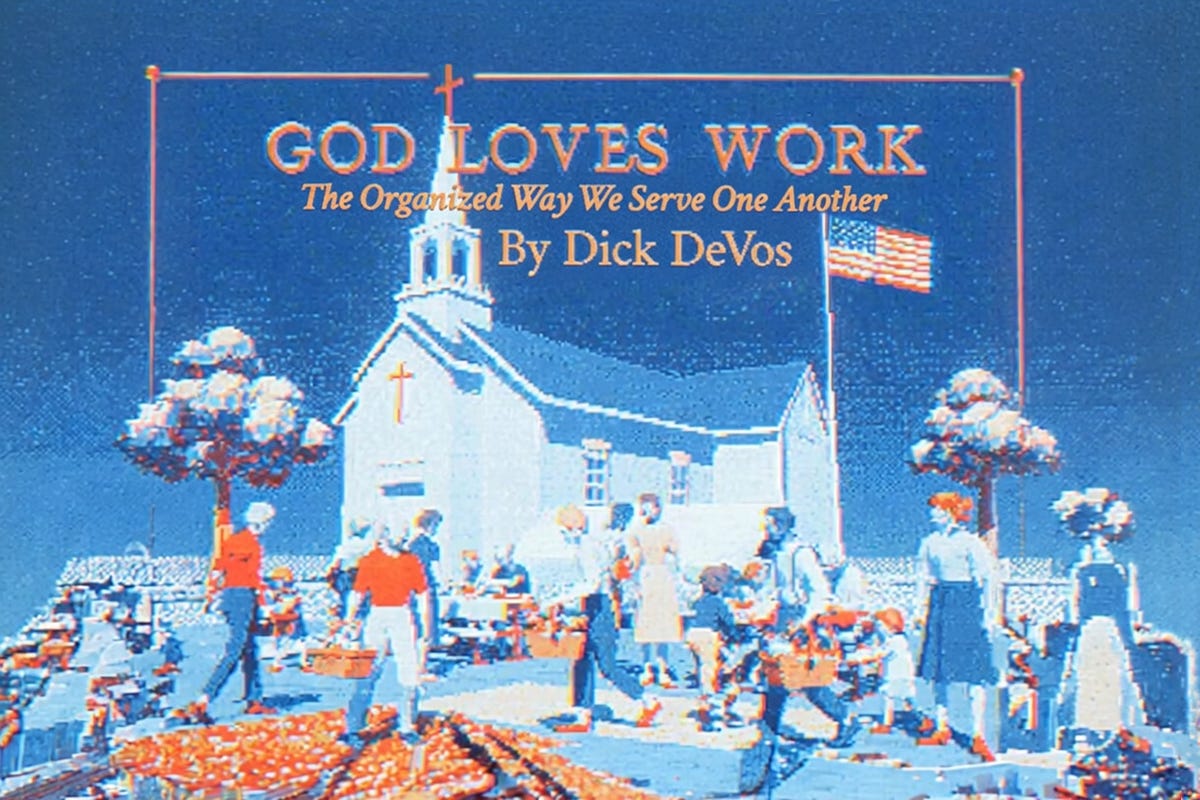
I have a deeply held belief that work is the organized way we serve one another. Think about that. At a time when people speak a lot about seeking real meaning in life—especially amid the rise of AI—the work we do can in fact provide us with exactly the significance and purpose people want. Through our work, we serve our communities, our customers, our friends and neighbors. That sense of purpose is the real “why” behind our willingness to challenge ourselves, expend our energy, and spend time away from family, friends, and other passions.
This idea is shared by many Christians. Our faith places a strong emphasis on service, community, and the responsible use of our individual gifts. The work we are entrusted with and the jobs we hold are possible only because of the talents, skills, and opportunities God has given us, and the results are ultimately for His glory.
Yet, regrettably, there’s this growing notion that work has become a burden. It’s often framed as an obstacle to enjoyment, a necessary evil, boring at best, and merely “a way to pay the bills.”
But work, in all eras, is inherently meaningful and important to life. In my book Rediscovering American Values, I wrote some years ago now that too many children were never taught the value or dignity of hard work. That concern feels even more urgent today, as social media and AI increasingly promote an alternative and often dismissive view of work, and all too often frame success as more the result of “good timing” or “luck” than diligence, patience, and hard work.
If you view work this way—if you see life simply as an endless cycle of working to eat, eating to live, and living to work—then work could certainly feel pretty uninspiring and even depressing.
But if we adopt a different perspective, as our faith teaches many of us to do, we recognize that work is more than just a job, a title, or a place of employment. Work is how we use what God has given us to improve our world, to create, to serve, to produce, or simply make something better.

When short-order cooks prepare hamburgers, they are feeding others. When autoworkers assemble vehicles, they are building a safe way for others to get around. When hospital workers empty bedpans, they are helping others heal. Even using AI can have a positive impact, though we shouldn’t mistake it for a replacement of human effort or intelligence.
We should challenge any notion that minimizes the role work plays in our lives. While a paycheck matters, it is not the whole story. Our commitment in every area of endeavor brings a unique meaning and completeness to living. Your job can provide incredible purpose and significance, if you let it.
From Rediscovering American Values, Chapter 4: Work

As old-fashioned as it may sound, work is a necessary part of keeping our commitments, and it is essential to becoming free. After reading the stories about Bessie Pender and John Jeavons, no one could doubt that they had to work to accomplish their goals.
The term “work” doesn’t just mean holding a job. It refers to activities that produce something, improve something, or better people’s lives. Work includes the daily effort of raising children or cleaning a floor as well as designing a new marketing strategy, making tiles for the space shuttle, or leading an army into battle. Each activity is a form of work and should be meaningful and rewarding.
The writer Studs Terkel defined work in this way: “Work is about daily meaning as well as daily bread for recognition as well as cash for astonishment rather than torpor for a sort of life rather than a Monday through Friday sort of dying.”
I believe that work is good only if it leads the worker to freedom, reward, recognition, and hope. In other words, work must be satisfying psychologically and spiritually as well as financially.
The idea that work in and of itself can be meaningful and rewarding is sometimes lost on people. And given the fact that more of our time is spent at our jobs or traveling to and from our jobs than in any other activity, it is unfortunate when the jobs don’t provide joy or fulfillment.
It may seem silly to take time to define “work,” because it’s a word each of us frequently uses. This, however, is all the more reason to do so, because we often use it without really comprehending its true meaning. Perhaps if we were to better understand the dynamics of work, we would better understand and appreciate its value.
Work involves energy. The word “energy” comes from the Latin energon, which is composed of en, which means “at,” and ergon, which means “work.” In the field of physics, work is described simply as the “transfer of energy from one system to another.” If we were to think of work as a transfer of energy, and apply this concept to our everyday lives, then much of what we do would be categorized as work. If you studied physics, you might remember that energy cannot be created or destroyed, it can only be transferred or transformed. Even when we are simply breathing, sleeping, or moving, we use energy.
In order to keep breathing and moving we must replace the energy we use with the food we eat. In order to provide the body with food, we must either sow, nurture, and harvest the food, or earn the money to buy it. Those activities obviously expend more energy, which then must be replaced. Thus, it becomes clear that our “daily work” is but one link in a cycle of energy transfer. One may wonder if life is worthwhile if we just eat to live, live to work, and work to eat. It all sounds very uninspiring. Our pets may be content to lead their lives this way, but it is not, for the most part, something that most human beings would find particularly exciting.
All work can and should be meaningful. Some people speak of important jobs and menial jobs, but the success of any organization or effort depends on the contributions made by different individuals fulfilling different responsibilities. Work that is fulfilling for one person may not be fulfilling for another.
The attitude we bring to work plays an important role in our enjoyment of and our ability to fulfill the task. If, when short-order cooks are preparing hamburgers, they can remember that what they are doing is feeding families; if while emptying bedpans, hospital orderlies recognize that they are playing a role in healing people; and if autoworkers are aware that they are not just working on an assembly line but offering safety and mobility to fellow citizens, then their work takes on greater meaning.
If our attitude toward our work is right and we still don’t derive satisfaction from it, it may be that what we are doing does not line up with our God-given talents. I believe that we are called by God to utilize the skills He gave us to perform certain kinds of work. When we perform our work with integrity, it becomes a form of ministry. My faith teaches me that all work should be done for the glory of God. Therefore, all work is significant regardless of its financial reward.

A man who understands the transformational power of work is Willie Gary, an inspirational public speaker, devoted husband, and gifted trial attorney. The framed diplomas on the walls of his office in Stuart, Florida, are a testament to his work as a scholar and jurist. A look at his hands, however, reveals his humble origins.
He has known hard physical work, and plenty of it. He is a man, one might say, who realized early on that his best friends were his own hands.
The son of migrant farmworkers, Gary grew up with ten brothers and sisters in the back of a stake truck. There were peaches to harvest in Georgia, apples to pick in North Carolina, and beans to pick in Florida. All there was to life, it seemed, was hard work.
Like other children of migrants, Gary attended school in the mornings and worked with his parents in the afternoons. “There was no such thing as day care,” he says, “only field care. That’s the older children watching the younger children so they stay out of the way of the adults.”
Rather than resent the hours he spent in the steaming hot fields, Gary was grateful for the opportunity to help out, because his contribution directly translated into tangible rewards at the dinner table. “You quickly learned the value of a day’s labor, of helping yourself and making your own way.”
From his many aunts and uncles, who routinely joined his family for Sunday services, which were delivered from a pulpit made of stacked packing crates under a shade tree at the edge of a farmer’s field, he was also taught to play by the rules, to treat people the way he expected to be treated, and to help his fellow man.
Gary’s father, more than anyone else, taught him about working hard. “My dad didn’t know what giving up was all about,” Gary remembers. “No matter what it was, tilling the soil, picking fruit, or selling melons from the back of a truck, he did it better and longer than anyone else. He grew the best crops, picked the most fruit, got the best prices. It was all right to make mistakes, but you had to get back up and keep trying. The true champions always got back up off the mat.”
By the time Gary reached his sixteenth birthday his father had saved enough money to buy a small bean farm outside of Indianhead, Florida. Gary still helped some on the farm, but now he was enrolled in high school and was expected to work hard in the classroom and on the football field. By sheer hard work he did well in both, but neither his grades nor his athletic ability was enough to get him a scholarship to college.
Every school Gary applied to turned him down for a scholarship. After he repeatedly asked his teachers for help, his football coach managed to arrange for an interview at Shaw College in Raleigh, North Carolina. When Gary stepped off a Greyhound bus in Raleigh, with a suitcase tied closed with a rope, all his family’s hopes and dreams were riding with him. No other African-American man from Indianhead, Florida, had ever attended college.
Gary’s hopes were soon dashed when he discovered that the football coach he had been sent to see didn’t seem to know why he had come, and wasn’t interested in the details. “I’m really sorry,” the coach said. “I don’t have an opening.”
Gary had no money to get home, or even to make a telephone call. Unsure of where to go, he visited the dorm where the football players lived, hoping they might sneak him some food from the cafeteria. He spent the night on a sofa in the lounge.
Gary didn’t feel right about living off handouts in the school dorm, so the next morning he decided he was going to work for his keep, even if he didn’t get paid. He followed the football players into the locker room. After they had suited up and left for the field, he straightened up their clothes, put the supplies away, and washed the floors. Later, when the players returned from the game, showered, and left, he cleaned up again.
The assistant coach told the coach what was happening, and the coach called Gary into his office. “I’ve heard you’re doing a good job in the locker room,” the coach said. “Here’s a meal ticket. It’s the least I can do.” The next day Gary helped the trainer carry equipment onto the field. Again, the coach took him aside. He asked where Gary was sleeping. Gary lied and said that he had a place to stay. “No you don’t,” the coach corrected him. “I’ll get you a bed in one of the dorms until the end of the week. Then you’ll have to go home.”
Gary thought he had reached the end of the line when football practice was over on Friday afternoon. He had no job prospects, and although he had filled out an application to the college, he hadn’t been able to pay the fee to submit it. When the assistant coach told him that the head coach wanted to see him, Gary expected to be told that he had to give up his meal ticket and vacate the dorm room. But the coach surprised him.
“I’m glad you didn’t go home,” the coach said. “A linebacker has been hurt during practice. You can have his spot if you want it.” The uniform they gave Gary was too big for him, but he quickly grew into it. And his hard work paid off, on the field and in the classroom.
Not only was Gary the first African-American student in his hometown to get a degree, he was the first black student from his hometown to even go to college. With help from college faculty members, Gary applied and was accepted to law school at North Carolina Central University.
Again, he poured every ounce of his energy into working hard. And three years later, Gary, now married to his childhood sweetheart, became the first black lawyer to practice in Stuart, Florida. Soon, however, Gary began to wonder if all his hard work was for nothing. No matter how much he advertised, or what credentials he had to offer, he couldn’t get a paying client.
But he decided he wouldn’t let that stop him. He would provide his services free of charge to anyone who needed his help. Eventually, Gary’s clients started paying him, and his practice got so busy that he had to take on partners.
Today, Gary’s firm is one of the most successful legal practices in the state of Florida. In fact, his practice is so prosperous, and Gary is so grateful for the help he received from Shaw College, that recently he donated $10 million to endow scholarships, hire faculty, and support a building fund for that school.

By utilizing his God-given talents, having the courage to press on, and remaining committed to his goals, Gary was fulfilling his life’s purpose.
My parents gave me a firm foundation when they taught me the joy of utilizing my God-given talents and working to the best of my ability. And no matter how menial the task seemed, it was significant, whether I was weeding the flower beds or scrubbing the bathroom floor. Now having been blessed with success, I must work even harder to achieve new goals. In fact, like many today, I find that I have the tendency to go over the edge with work. However, I have learned it is important to keep our work in balance with the rest of our life and to be careful that we don’t define ourselves only by the work we do.
I strongly believe the significance of what we do is not limited to the hours we spend at “work.” Our commitment in every area of endeavor brings a unique meaning and completeness to our lives. This was certainly true for ecologist John Beal.
When Beal decided to clean up Seattle’s Hamm Creek, most people who knew him would have agreed that he was not the kind of person anyone would put in charge of a fifty-five-square-mile watershed. He was a high school dropout, a former rodeo cowboy, a Vietnam veteran with post-traumatic stress disorder, and an armchair environmentalist. He hadn’t held a steady job in more than a decade. And two heart attacks, a motorcycle accident resulting in a head injury and epilepsy, and the diagnosis of post-traumatic stress disorder, all within a period of one year, had convinced doctors that he had only a few months to live.
Beal didn’t let this stop him. He knew no one would trust him with the restoration of Hamm Creek, so he took the job on himself, asking nothing more for his efforts than the pleasure of leaving this tributary of the Duwamish River a little better off than when he found it.
“I guess I had come to the point in my life when I looked back and saw that I hadn’t contributed much to this world. You might say, I had left the world a lot worse off than the way I found it. The only reason I chose Hamm Creek was because it was so close to my house and in such bad shape.”
At the time, almost everyone had written Hamm Creek off as nothing more than a drainage ditch carrying factory runoff and residential waste into the befouled Duwamish River. So neighbors stood on the banks and gawked as Beal began his work. First he dragged a discarded refrigerator out of the muck. Next came tires, old television sets, scrap metal, paint cans, car parts, and an assortment of other waste. In less than a year he had dragged over one ton of trash out of the creek. City authorities carted away the first load as Beal tackled another section of the creek.
Beal had expected to be dead of a heart attack before he could finish cleaning the trash out of the creek, but the heart attack didn’t come, so he decided to beautify the creek by planting grass and small trees and shrubs along its edges. Once his beautification plan was under way, he put some crayfish in the water. They died almost instantly.

“I suppose that’s when I had to get serious about what I was doing. Before that, all the changes were cosmetic. Now I had to deal with the fact that the stream water itself was poisonous. I didn’t think I was going to be able to reverse something that was fifty years in the making, but I decided at least to give it a try.”
He first had to deal with all the oil and petroleum products that were polluting the creek. The plants and ground cover he had installed along the banks did some good, but not nearly enough. Amateur investigating revealed that a company was paying a contractor to dump its petroleum by-products directly into the river on a regular basis. Beal confronted the truck driver, who said, in effect, “I need the money.” The manager who hired the contractor echoed similar sentiments. “My company won’t be competitive if I pay to have the waste recycled.”
Beal knew that calling the authorities wasn’t going to solve the problem. Besides, neighbors would lose their jobs if he caused the company to be shut down. So Beal decided to find an economic solution that was right for the business as well as for the creek. The solution came in the form of a recycling co-op in which business operators pooled their petroleum by-products to be resold later. The idea caught on in a major way.
“As soon as the business owners saw they could save money and save Hamm Creek, there was no longer an issue. They all fell in line.”
Later, these same companies became Beal’s supporters as he tackled the problem of pollutants draining into the creek from city streets and parking lots. He certainly couldn’t take the cars off the street, so he devised a unique filtration system that collected runoff oil in synthetic “booms” that floated on the creek’s surface. The only problem was what to do with the oil once it had collected in the boom. Again, Beal used his initiative. He discovered the solution growing right on the banks of the creek: buttercups.
Beal had noticed that while other plants couldn’t survive the toxic environment on the banks of the Hamm, these delicate and colorful yellow flowers flourished. “They literally drink up the oil,” Beal reported. “I had only to plant them on the booms.”
Again, Beal tried to put crayfish in the Hamm. And again they died, but this time it took ten days. “There was still something wrong,” Beal said. “And I thought I knew what it was.”
Beal took a soil sample from the streambed to the University of Seattle for analysis. Just as he had suspected, the soil itself was contaminated with high levels of heavy metal that had accumulated since the turn of the century. Beal experimented with shoveling sections of the creek bottom into drums, but the cost of disposing of it became prohibitive. He solved his problem, instead, by sinking low-level electromagnets into the streambed. The magnets collected the heavy metals, which he then turned over to a cement company. They, in turn, poured the contaminants into concrete.
“I was astonished at how quickly we got the stream cleaned up. At first, no one I told would believe it because they didn’t think it was possible to reverse so many years of neglect. The evidence, of course, was the stream itself.”
First the water bugs and crayfish returned. Then a pair of red-tailed hawks, hand-raised and introduced by Beal, set up a home on the creek’s banks. Beal also introduced foxes, moles and voles, and many species of ants. The real thrill, however, came when coho salmon, planted in the creek, returned to spawn. The entire venture has been so successful that hundreds of schoolchildren and environmental groups have embraced Beal’s efforts. The technology and methods he brought to Hamm Creek are now being used on five other streams, two lakes, and the entire Duwamish River. Environmental groups have taken the same technology to Russia and India.
Seventeen years after Beal began his cleanup, the mud from Hamm Creek is so pure that it is being used at some exclusive health clubs and resorts. “Promoters are calling this the healing waters of Hamm Creek,” Beal says.
They may be right. His initiative and hard work have restored the land and given him a new lease on life. What a tremendous example of remaining committed to a goal and persevering to get the job done.

Unfortunately, many children today have not learned the value of work. A few generations ago, children worked alongside their parents; the participation of a child was expected. When a child is not taught the value of helping attain family goals, the actual process of work is divorced from its end result. For instance, work becomes an abstract notion when a child believes that money comes from a cash machine at the bank. This was certainly not the case when children apprenticed under their parents. Many of today’s children don’t experience completion of a job, or feel the surge of pride that comes with it. Oftentimes the experiences they have with work are the assorted tasks or chores that parents assign them, and the only motivation they have is fear of being punished or being called lazy if they don’t comply. The idea that work can be passionate, spontaneous, and fun is often missing from the equation.
If we are going to help our children to become self-reliant and fulfill their life’s purpose, we are going to have to teach them the joy and dignity of work.
No matter what it is that we do, whether on the job, in our marriage, at school, in our place of worship, or in our community, we must be advancing God’s work. The Hebrews called this shalom. In the Bible, shalom is described as universal flourishing, wholeness, and delight, or simply peace. It’s the way things ought to be. Everything that we do could and should contribute in some way to this goal. It is the biggest “work” project in the universe, and we are called to preserve and accomplish the task.
Dick DeVos is a Michigan-based businessman, author, and philanthropist whose book, Rediscovering American Values, connects the moral foundations of the American way of life to its outcomes: hard work, self-discipline, leadership, and innovation.

Amen
Thank you so much for this. It came at the perfect time for me. The legacy you and your parents and the Van Andels have left for this great experiment called America is without measuresl.