


I once told the President of the United States that I liked a different President better.
The year was 2005. The place was the Oval Office. And the President I spoke with was President George W. Bush. I was there to discuss a volume of George Washington’s presidential papers that I had co-edited. For 30 minutes, we had a far-ranging conversation about presidential leadership and American principles.

As a history professor, it was amazing to sit and speak with a sitting president about his favorite presidents. And yes, I told him that I preferred the first “GW”—George Washington. He didn’t seem to mind. In fact, he seemed to agree!
But our wide-ranging, pleasant, and apolitical conversation is not the thing I remember most about the meeting. What I remember most is looking out the windows of the earth-toned Oval Office into a sunny D.C. afternoon and thinking:
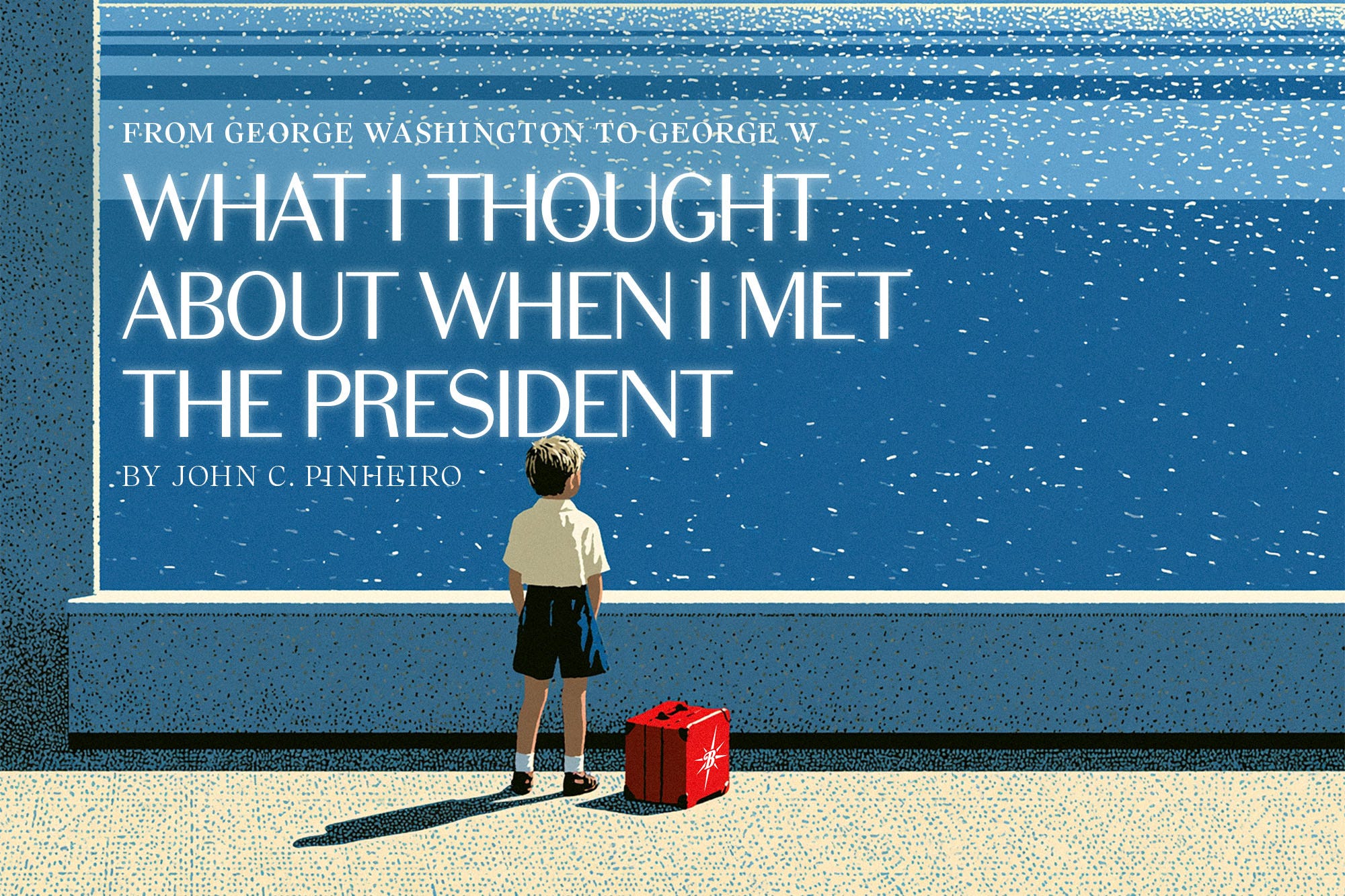
“If only my illiterate, immigrant grandfather could see me now. What would he think about America and his choice to leave Portugal, alone, as a twelve-year-old boy who spoke only Portuguese?”
My story is not unique in American history. Stories of the children and grandchildren of immigrants are varied and numerous. Stories from entrepreneurial immigrants with successful businesses are equally bountiful. And today, as I think back on my meeting with President Bush, I reflect with gratitude on America’s 250 years of economic freedom and opportunity, because that’s what drew families like mine to these shores.

To this day, America is always—always—at the top of the wish list for those who want a brighter future for themselves and their families and who are willing to work for it.
I say this even as the immigration debate rages in America. We can and should argue about which policies promote human flourishing and economic independence. We can talk about how to avoid creating a habit of dependence on government benefits. We can also debate what helps or hinders assimilation, how to face the moral evil of human trafficking, how to assess the economic impact of remittances that are sent back to one’s country of origin, and how to measure immigration’s effects on employment and productivity.
But what’s inarguable is the long-running attraction of America to those seeking freedom and a better life.

As my Acton Institute colleague, Dr. Stephen Barrows, has written, those who dislike immigration today “too often reduce people to zero-sum consumers of their country’s resources and underestimate each migrant’s potential, while others persist in treating refugees with a permanent emergency and segregation mindset. Open-border zealots ignore the importance of enforcing the rule of law and underestimate the harm such neglect entails for both migrants and native citizens.” He concludes that, “migration, though accompanied by challenges, can bring great blessings to society if it is properly circumscribed with sound policy.”
It was George Washington who struck a sound balance between openness to immigration with the need for assimilation. In 1783, Washington wrote to Joshua Holmes, “The bosom of America is open to receive not only the Opulent and respectable Stranger, but the oppressed and persecuted of all Nations and Religions; whom we shall welcome to a participation of all our rights and privileges, if by decency and propriety of conduct they appear to merit the enjoyment.”

In fact, George Washington knew someone who embodied this vision: Alexander Hamilton. Many Americans are familiar with Hamilton today because Lin-Manuel Miranda reconceived his story, presenting Hamilton as “another immigrant coming up from the bottom.” Hamilton, an orphan from the Caribbean, certainly did come “up from the bottom.” At twenty he became General George Washington’s aide-de-camp during the Revolutionary War. Hamilton authored the call for a Constitutional Convention and penned the majority of the Federalist Papers. Then he became Washington’s Secretary of the Treasury. Even Thomas Jefferson, Hamilton’s political nemesis, admitted that Hamilton was “a colossus.”
As a nation, we should seek to welcome as many such colossi as possible. And we should also seek to encourage the blessing of liberty across the world, so that people don’t feel compelled to find it only in America. To quote the first “GW,” who I told the second “GW” that I preferred: “It is much to be wished that the blessings of equal Liberty and unrestrained Commerce may yet prevail more extensively.”
John C. Pinheiro, Ph.D., is Director of Research and Publications at the Acton Institute. A historian, he is the author or editor of five books, speaks widely on the American founding, and is a frequent contributor to many journals and magazines. His most recent book, with Dylan Pahman, is The Christian Roots of American Liberty: A Reader. He frequently writes on Substack at Liberty & Order and on X at @DrJohnPinheiro.

