



Faith is the first thing in the backseat when things get busy. Prayer becomes a chore. Daily devotionals are squeezed in without thinking. That Scripture verse your pastor or priest preached about last weekend? You didn’t understand a word. Maybe the preacher didn’t either. You don’t know where to begin making sense of it.
You’re going through the motions and need a solution. Why not turn to your favorite LLM, like you do for everything else?
More and more Christians are asking this question. Because sure enough, a chatbot can make a pretty decent prayer or devotional routine for you. It can give a more-or-less accurate interpretation of a Bible passage. It can even quote scripture and tell you what it means.
But stop right there: Is “pretty decent” what we want in our faith life? It’s not that we seek to be perfect Christians, the whole point is that this is impossible. But shouldn’t the materials we use to worship be more perfect than us? Like, you know, the Bible? Is AI really a viable shortcut?

Spending time in prayer and spiritual study is supposed to take time, because it matters so much. If you outsource that job to a chatbot, you’re short-changing your growth in faith.
You also run the risk of misshaping your soul. For all its power, AI is well-known for giving false answers, called “hallucinating.” It often makes up facts or outright lies. And chatbots have a history of reinforcing your own ideas, no matter how misguided they are. That’s a terrible thing if you’re already struggling to understand or practice your faith. You could be led in the wrong direction—while thinking AI is steering you right. In extreme cases, this leads to something termed “ChatGPT Psychosis,” where AI “hallucinations” creep into the real world by affirming users’ incorrect or delusional beliefs.

Now for the absolute worst-case scenario: You may turn the chatbot into your savior. What started as a way of helping you understand God comes to supplant God. You trust the machine to guide you on the straight narrow. You put your faith in a tool, instead of something ineffable. There’s a name for this: idolatry. And Christianity is clear that idolatry is wrong.
The antidote to false idols is discernment. Jeremiah 23:16 says, “Do not listen to the prophets who are prophesying to you; they are filling you with false hopes… They speak visions from their own minds, not from the mouth of the LORD.” In 1 John 4:1, we’re warned to “not believe every spirit, but test the spirits to see whether they are from God.” Augustine takes the problem of misinterpreting Scripture one step further:
Whoever, then, thinks that he understands the Holy Scriptures, or any part of them, but puts such an interpretation upon them as does not tend to build up this twofold love of God and our neighbour, does not yet understand them as he ought. If, on the other hand, a man draws a meaning from them that may be used for the building up of love, even though he does not happen upon the precise meaning which the author whom he reads intended to express in that place, his error is not pernicious, and he is wholly clear from the charge of deception.
It’s a mouthful, but in essence, it serves as both a warning against and permission to use AI as a shortcut in pursuit of higher knowledge. One who understands the letter of Scripture without enacting its essence misses the point—as is often the case with AI. But one who enacts the essence without full scholarly understanding still does good.

Indeed, in Matthew 5:20, part of Jesus’ Sermon on the Mount, he says “For I say to you that unless your righteousness surpasses that of the scribes and Pharisees you will not enter the kingdom of heaven.” What he means here is that the letter of the law, on its own, isn’t enough. With it must also come a passionate application in your own life. LLMs are certainly the “scribes” of our day, and if you allow them to dictate your faith, you are arguably missing the purpose of faith itself.
So how to handle all this? If you’re thinking of using AI in matters of faith, here are some questions you might ask yourself. We recognize that we’re not theologians or canon lawyers, but we still think this is a helpful exercise.
First, am I using AI to avoid spending time in prayer or formation? We can’t let AI become an excuse to do the hard work of putting faith first. While it’s tempting to think that a 30-second chat with the robot fulfills our religious obligations, it doesn’t. Like all good things in life, faith demands attention and time.
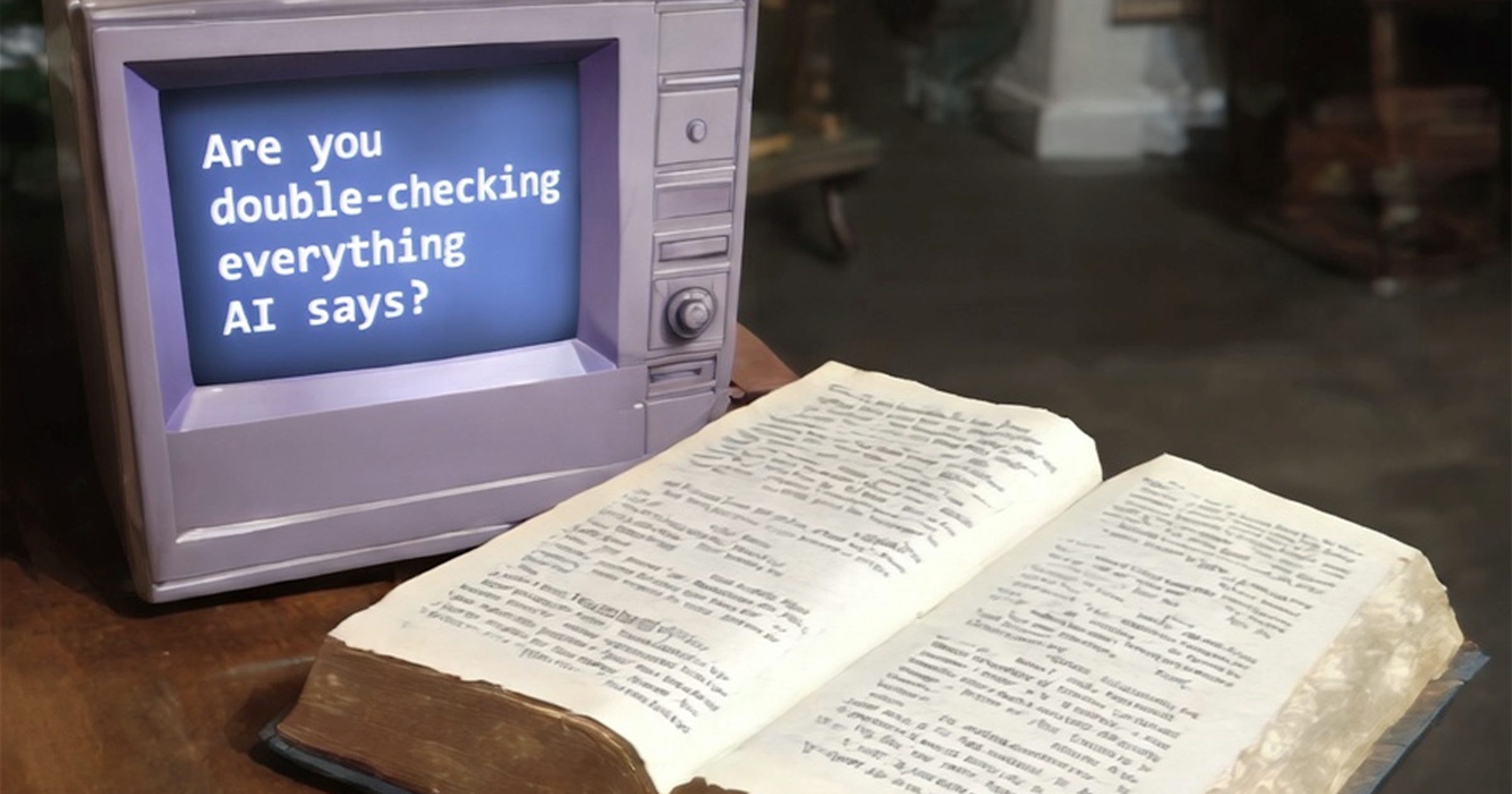
Second, am I double-checking everything AI says? We have a duty to ensure that chatbots don’t feed us lies instead of Biblical truth. Insofar as we use this technology, our attitude should be: Trust but verify. All those AI hallucinations get even more dangerous when your eternal soul is on the line.
Third and finally, is AI helping me grow closer to God? That’s the point of prayer, studying Scripture, and grappling with the meaning of belief and life itself. Anything that pushes us away from God stops us from answering His call in our life. AI, used conscientiously, can be a supplement to this relationship, but never a substitute for it.
If your answer to any of these questions is no, take a step back and reconsider how you’re using AI. Nothing is more important than your faith, and nothing builds faith better than old-fashioned engagement with Scripture, clergy, and your fellow congregants. AI can be helpful, but the Devil is in the details—and AI, as we’ve learned, has yet to get a handle on those.
