


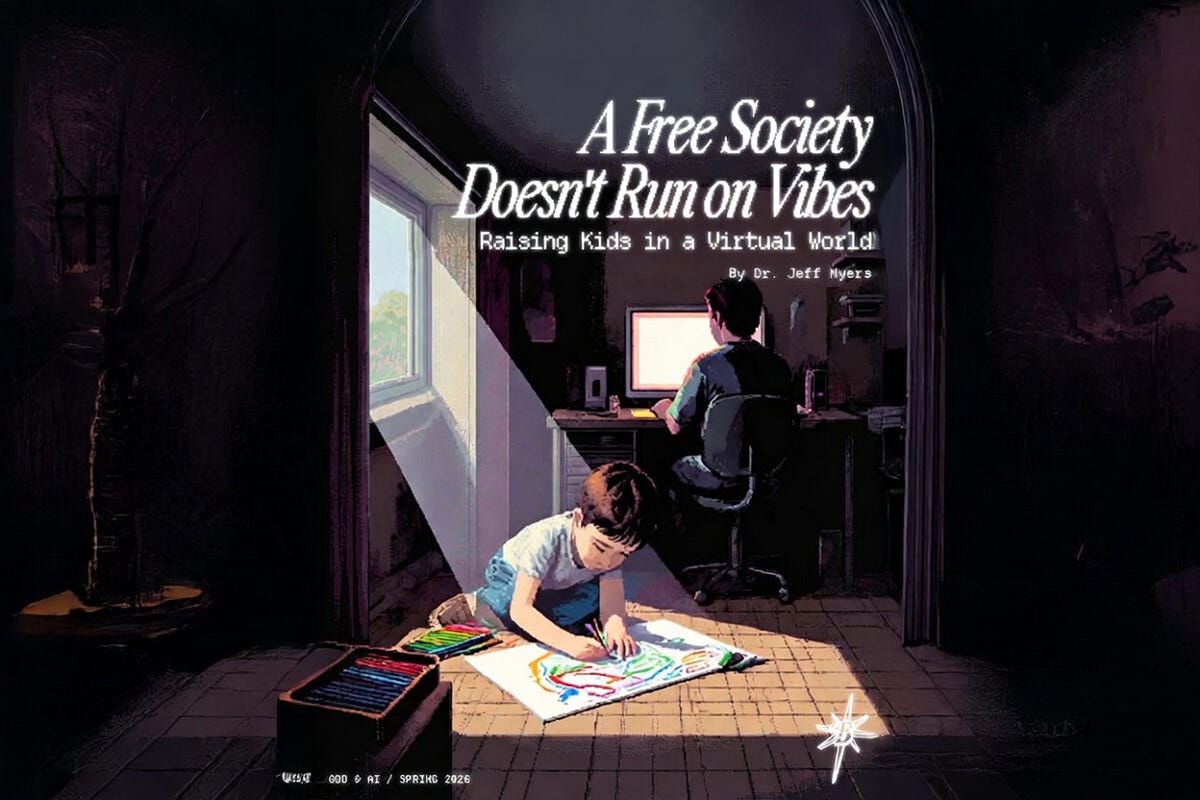
Ninety-six percent of U.S. teens say they are online daily, according to a Pew Research Report. Half say they are online “almost constantly.” And it’s not just social media. Seven in ten young adults say they use generative AI. They find it so absorbing that 83 percent say they can form a “deep emotional bond” with a chatbot.
Parents still love. Teachers still teach. Pastors still preach. But the most frequent voice many teens hear is an algorithmic one designed to capture attention rather than cultivate wisdom. The virtual world is teaching our kids that “yes” is the only acceptable answer to what they crave, and “now” is the only acceptable time.
Author and therapist John Eldredge thinks our forebears would be horrified by this. They considered waiting to be formative for the soul. But now, Eldredge says, “the internet has conditioned your soul to expect immediate answers”.

As a guy who’s trained more than a million young people in leadership, here’s what I know. A free society doesn’t run on vibes. It runs on virtue. Every minute we spend in the virtual universe is shaping our worldview, making us think that amusing ourselves is the same thing as living with meaning.
The online battle for our attention is a battle for America’s soul because whatever we pay attention to shapes our character, for better or worse. Good character builds a great nation. Bad character destroys it.

We know all this. But what do we do? Here are seven messages our kids need to hear from us over and over again:
1.“Let me remind you of who you are.” Our kids are not valuable because of the information they have access to, but because of who God created them to be. They were designed to live with dignity and recognize it in others, work hard, be honest, and serve those around them.
2. “We use tools; we don’t let them use us.” I often remind young adults, “If you’re getting something for free, then you are the product.” Our kids are not products to monetize. They are souls to shepherd. Their value is not something we should outsource to an unknown software engineer in a cubicle far, far away.
3. “I want you to grow in what matters most.” Is our use of technology helping us realize our potential, or just pass time? Is it causing us to look to God, or look away? Is it fostering good thinking and hard work, or is it just an easy shortcut? Is it connecting us to our family or tearing us away? These are questions every teen—and adult—should ponder daily.
4. “The most successful people learn to become comfortable being uncomfortable.” Resilience comes from working hard at something, right up to the point of failure. Just as an athlete strengthens muscles through a hard workout, we strengthen our minds by refusing the path of least resistance. We give ourselves time to sit in the grass, think, ponder, and wrestle with what we’re learning rather than outsourcing our thinking to AI.
5. “Let’s put our devices down for two hours.” Sherry Turkle, best-selling author of Alone Together, said in an interview that “Eighty-nine percent of Americans say that during their last social interaction, they took out a phone, and 82 percent said that it deteriorated the conversation they were in.” Our devices are getting in the way of the love and caring we hope to demonstrate. Phone free times are great for adults as well as kids.
6. “You need old people.” Nothing replaces the wisdom of real people with life experience. The people on TikTok don’t know you. They don’t love you. They just want your attention. We should instead aspire to be like the men of Issachar in 1 Chronicles 12:32 who “understood the times and knew what to do.” That kind of discernment doesn’t come from scrolling; it comes from seasoning. The best people to hang out with are those who’ve been through hard things and can remind us, “Chin up. You’re going to make it. Be strong.”
7. ““Let’s have dinner together.” Over the past 30 years, family time at the dinner table has declined about 30 percent, and even that time is rarely used intentionally. Studies show a correlation between how often families have dinner together and kids’ academic performance.Involving kids in planning, preparing, and enjoying device-free meals teaches a skill and shapes a desire that produces lifelong benefit.
The glowing screen in a teenager’s hand is not just a device. It’s a doorway. If we don’t guard that doorway, faceless algorithms will. A strong generation rises on virtue, not virality. Let’s double down on using technology wisely. If we don’t, it will surely use us.
Jeff Myers is president of Summit Ministries, America’s largest and most well-established Christian worldview training organization. Find out more at www.summit.org

